
Business
MrBeast Sparks Debate with Neuralink’s “Infinite Money Glitch”

Billionaire YouTuber and media personality MrBeast recently generated controversy with claims about the potential of Neuralink to create an “infinite money glitch.” During a podcast appearance, he suggested that the brain implant could enhance creativity and lead to substantial financial gain, a statement that has drawn skepticism from critics and fans alike.
In a clip from a podcast hosted by the Nelk Boys, MrBeast expressed his intention to get Neuralink once it becomes widely available. He stated, “Once the Neuralink actually works and you can have symbiosis with technology and just download things to your brain, you’ll be able to make so much money that it doesn’t matter how much the procedure will cost; anyone will be able to afford it.” His comments have sparked significant discussion online, particularly regarding the feasibility and implications of such technology.
Neuralink, founded by Elon Musk, is focused on developing implantable brain-computer interfaces that connect brain activity to external devices. While the technology has shown promise in limited trials, including a quadriplegic patient who successfully communicated using the device, the notion of downloading ideas directly into one’s brain remains speculative.
The phrase “symbiosis with technology” used by MrBeast has been criticized for its vagueness. Critics argue that the idea of seamlessly integrating technology with human cognition is largely theoretical at this stage. Furthermore, many have pointed out that MrBeast’s assertions about generating wealth through ideas do not reflect the complexities of the financial landscape.
In response to MrBeast’s remarks, TikTok creator Drey, who specializes in tech and politics, raised concerns about the misleading nature of his claims. She emphasized, “Ideas don’t make you money. They only make you money when you own them.” Drey further explained that wealth is often tied to copyright laws and the exclusivity of intellectual property, suggesting that if Neuralink were to interface continuously with individuals’ thoughts, ownership and profit could be compromised.
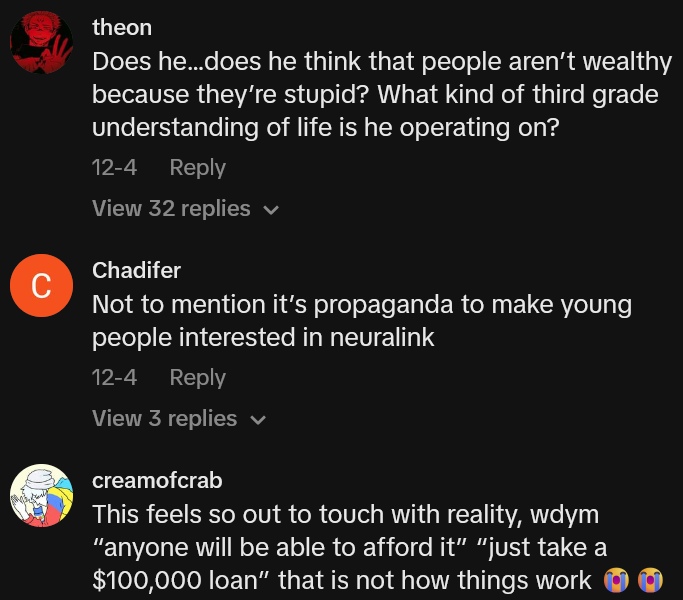
Critics of MrBeast’s assertions shared their thoughts on social media. One commenter questioned, “Does he think that people aren’t wealthy because they’re stupid?” while another remarked, “MrBeast has to be capitalism’s final boss,” highlighting the simplistic nature of his reasoning about wealth generation.
The conversation surrounding MrBeast’s podcast statements underscores a broader discourse about the implications of emerging technologies and their intersection with capitalism. As advancements in brain-computer interfaces progress, the potential for both innovation and ethical dilemmas will likely remain at the forefront of public debate.
As this story continues to circulate, it reflects not only the fascination with cutting-edge technology but also the need for critical discourse regarding its implications in contemporary society. The intersection of technology and economics remains a contentious topic, especially when figures like MrBeast leverage their platforms to discuss speculative ideas.

Discover New Reads: Hardin County Librarians Share Top Picks

Trump Claims Iran Seeks Negotiations as Protests Death Toll Hits 544

Senate Advances Minimum Wage Hike and Allows Government Employees to Run for Office
DNC Chair Ken Martin Accuses Trump of Election Fraud Lies

Barbie Breaks Ground with First Doll on the Autism Spectrum

Rachel Campos-Duffy Exits FOX Noticias; Andrea Linares Steps In

Piper Rockelle Shatters Record with $2.3M First Day on OnlyFans

Meta’s 2026 AI Policy Sparks Outrage Over Privacy Concerns

Leon Goretzka Considers Barcelona Move as Transfer Window Approaches

Urgent Update: Denver Fire Forces Mass Evacuations, 100+ Firefighters Battling Blaze
-
Top Stories1 month ago
Rachel Campos-Duffy Exits FOX Noticias; Andrea Linares Steps In
-
Top Stories1 week ago
Piper Rockelle Shatters Record with $2.3M First Day on OnlyFans
-
Top Stories6 days ago
Meta’s 2026 AI Policy Sparks Outrage Over Privacy Concerns
-
Sports5 days ago
Leon Goretzka Considers Barcelona Move as Transfer Window Approaches
-
Top Stories1 week ago
Urgent Update: Denver Fire Forces Mass Evacuations, 100+ Firefighters Battling Blaze
-
 Top Stories1 week ago
OnlyFans Creator Lily Phillips Reconnects with Faith in Rebaptism
-
 Top Stories6 days ago
Warnock Joins Buddhist Monks on Urgent 2,300-Mile Peace Walk
-
 Entertainment6 days ago
Tom Brady Signals Disinterest in Alix Earle Over Privacy Concerns
-
 Top Stories1 week ago
Oregon Pilot and Three Niece Die in Arizona Helicopter Crash
-
 Top Stories4 days ago
CBS Officially Renames Yellowstone Spin-off to Marshals
-
 Health2 months ago
Terry Bradshaw Updates Fans on Health After Absence from FOX NFL Sunday
-
 Sports4 days ago
South Carolina Faces Arkansas in Key Women’s Basketball Clash