Connect with us

Business

Family Tests Five Pickle Brands: Claussen Takes Top Honors

Editorial

Published

on

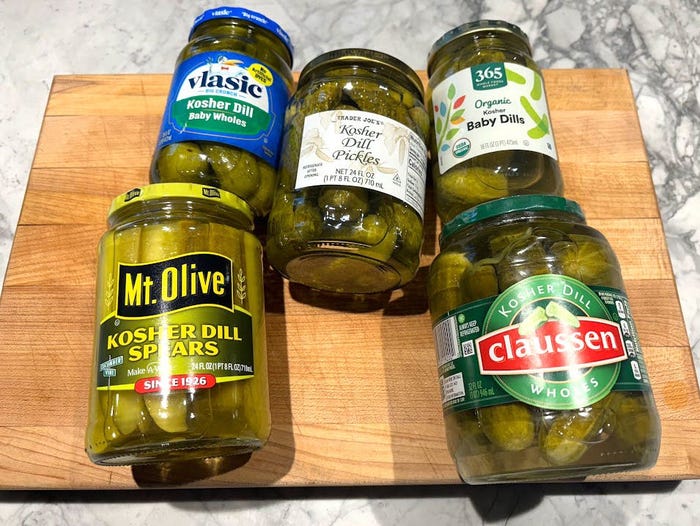
A family conducted a taste test of five brands of jarred pickles, ultimately declaring Claussen as their favorite. The taste test aimed to rank the brands based on flavor, crunchiness, and overall satisfaction, revealing varying opinions on each product’s quality.

Ranking the Pickles: From Least to Most Favorite

The family found the **Vlasic kosher dill baby pickles** to be the least favorable option, placing them at the bottom of the list. Available for approximately **$6 for a 16-ounce jar**, these pickles exhibited a satisfying crunch and an initial pleasant briny flavor. However, the aftertaste was off-putting enough that the entire family agreed they would not purchase this brand again. In a bid for clarity, a second jar was bought from a different store, confirming the unpleasant taste was consistent.

Next, the **Whole Foods 365 organic kosher baby dill pickles** were tested. Priced at **$5 for a 16-ounce jar**, these pickles fell short in terms of crunch and flavor. Although one family member preferred them, citing a milder taste, many found them lacking the expected crispness and tangy profile of quality pickles.

At **$3 for a 24-ounce jar**, the **Trader Joe’s kosher dill pickles** offered a budget-friendly option but did not impress the family overall. While they had a decent snap, the mild vinegar flavor and unfamiliar seasoning left them wanting more. These pickles seemed better suited for a cheese board than as a side to a burger.

The **Mt. Olive dill-pickle spears**, which cost **$4 for a 24-ounce jar**, evoked nostalgia for the reviewer. They were reminiscent of sandwiches from a local deli, featuring a classic pickle flavor that was tangy, albeit slightly mushy. The family noted that while these pickles may not have been the crunchiest, they delivered a satisfying taste that could lead to a future purchase.

Claussen: The Clear Winner

The standout choice was **Claussen’s kosher dill pickles**, which were priced at **$7 for a 32-ounce jar**. These pickles, found in the refrigerated section, offered a vibrant dill flavor and a crunchy texture that impressed the entire family. Their bright vinegary tang set them apart from the other brands. Despite the higher price, the family unanimously agreed that Claussen was worth the cost and would be their go-to brand in the future.

This tasting experience, conducted by Ted Berg and his family, highlights the subjective nature of food preferences while also emphasizing the importance of flavor and texture in popular snack items like pickles. The results of this informal taste test may guide other consumers in their choices when selecting jarred pickles at the grocery store.

This story was originally published on **January 7, 2025**, and was most recently updated on **November 19, 2025**.

Our Editorial team doesn’t just report the news—we live it. Backed by years of frontline experience, we hunt down the facts, verify them to the letter, and deliver the stories that shape our world. Fueled by integrity and a keen eye for nuance, we tackle politics, culture, and technology with incisive analysis. When the headlines change by the minute, you can count on us to cut through the noise and serve you clarity on a silver platter.

Continue Reading

Business

Boot Barn vs. MINISO Group: A Comprehensive Stock Comparison

Editorial

Published

on

Investors are closely examining the stock performance of two mid-cap retail companies: Boot Barn Holdings, Inc. and MINISO Group Holding Limited. Both companies offer distinct product lines and growth strategies, prompting a detailed comparison of their earnings, risk factors, valuation metrics, and investor sentiments.

Risk and Volatility Analysis

Boot Barn exhibits a beta of 1.61, indicating that its stock is 61% more volatile than the S&P 500. This heightened risk may appeal to investors seeking potential high returns, but it also raises concerns about price fluctuations. In stark contrast, MINISO Group has a beta of 0.09, suggesting that its stock is 91% less volatile than the market benchmark. This lower volatility may attract investors looking for stability.

Earnings and Valuation Metrics

In terms of financial performance, MINISO Group outpaces Boot Barn in several key areas. The Chinese retailer reports higher revenue and earnings per share, making it a strong competitor in the retail space. Furthermore, MINISO Group boasts a lower price-to-earnings ratio compared to Boot Barn, indicating that it may represent a more affordable investment option currently.

Institutional ownership also plays a significant role in investment decisions. Approximately 17.2% of MINISO Group’s shares are held by institutional investors, a sign of confidence in its long-term performance. Conversely, Boot Barn has only 0.7% of its shares owned by insiders, while MINISO Group enjoys a substantial 73.5% insider ownership, reflecting strong belief in its growth prospects among company executives.

Dividends are another critical aspect for investors. Boot Barn offers an annual dividend of $0.50 per share, resulting in a dividend yield of 0.3%. On the other hand, MINISO Group pays out an annual dividend of $0.56 per share, yielding 2.9%. The payout ratio for Boot Barn stands at 7.4%, while MINISO Group has a significantly higher payout ratio of 57.7%. Both companies maintain healthy payout ratios, indicating they can sustain dividend payments with future earnings.

Analysts are also leaning towards MINISO Group in their recommendations. Boot Barn’s consensus price target is $198.00, suggesting a potential upside of 2.47%. In contrast, MINISO Group’s price target is set at $25.13, reflecting a potential upside of 28.42%. This stronger consensus rating for MINISO Group may signal to investors that it is the more favorable stock at this time.

Profitability Comparison

A detailed look at profitability shows that MINISO Group excels in many metrics, including net margins and returns on equity and assets. This suggests that the company is effectively managing costs and generating higher returns on investments compared to Boot Barn.

In summary, MINISO Group outshines Boot Barn in nine out of sixteen factors compared across various metrics. The analysis indicates that while both companies have their strengths, MINISO Group presents a more compelling investment opportunity based on current data.

Boot Barn Holdings, Inc., founded in 1978 and based in Irvine, California, operates specialty retail stores that offer a range of western and work-related footwear and apparel. Its products are also available online through various e-commerce platforms.

Conversely, MINISO Group, established in 2013 and headquartered in Guangzhou, China, specializes in lifestyle products and toys. The company’s diverse offerings range from home decor to personal care items, showcasing its appeal across multiple consumer categories.

Investors interested in the retail sector should continue to monitor the performance of both Boot Barn and MINISO Group as they navigate their respective markets.

Continue Reading

Business

Ethic Inc. Reduces Stake in AGCO Corporation by Over 53%

Editorial

Published

on

Ethic Inc. has significantly reduced its stake in AGCO Corporation (NYSE: AGCO), selling 4,701 shares in the third quarter of 2023, according to a report from HoldingsChannel.com. This sale represents a decrease of 53.1% in Ethic Inc.’s ownership, leaving the institutional investor with 4,156 shares valued at approximately $445,000 based on its most recent filing with the Securities and Exchange Commission (SEC).

This reduction comes as part of a broader trend among institutional investors, with several firms adjusting their positions in AGCO. EverSource Wealth Advisors LLC, for instance, raised its stake by an impressive 951.9% during the second quarter, acquiring an additional 257 shares to reach a total of 284 shares worth around $29,000. Geneos Wealth Management Inc. also increased its holdings by 109.2% in the first quarter, now owning 364 shares valued at $34,000.

Other notable changes include Atlantic Union Bankshares Corp., which purchased a new stake worth $44,000, and Advantage Trust Co., acquiring a position valued at $52,000. Hantz Financial Services Inc. further expanded its investment by 1,425.0%, bringing its total to 549 shares worth approximately $57,000. Overall, institutional investors hold approximately 78.80% of AGCO’s stock.

Analyst Ratings and Stock Performance

Several financial analysts have recently assessed AGCO’s stock performance. JPMorgan Chase & Co. adjusted its target price from $127.00 to $123.00, maintaining an “overweight” rating. In contrast, Zacks Research downgraded the stock from a “strong-buy” to a “hold” rating. Additionally, UBS Group lowered its price objective to $115.00 while keeping a “neutral” rating.

Despite mixed reviews from analysts, the consensus rating remains a “hold” with a price target averaging $110.20. Currently, three analysts recommend a buy, eight suggest holding, and two advise selling the stock.

AGCO’s shares opened at $106.57 on Tuesday, reflecting a slight increase of 0.7%. The company has a market capitalization of $7.95 billion, a price-to-earnings (P/E) ratio of 21.19, and a beta of 1.17. Over the past year, stock prices have fluctuated between a low of $73.79 and a high of $121.16.

Recent Earnings and Dividend Announcement

AGCO Corporation released its quarterly earnings report on October 31, 2023, showing earnings per share (EPS) of $1.35, surpassing the consensus estimate of $1.26 by $0.09. The company reported revenue of $2.48 billion, meeting expectations but reflecting a 4.7% year-over-year decline. Last year, AGCO posted an EPS of $0.68 during the same period, indicating a substantial year-over-year improvement.

The company has set its fiscal year 2025 guidance at an EPS range of $5.00 to $5.00. Analysts forecast an average EPS of $4.20 for the current fiscal year.

Additionally, AGCO announced a quarterly dividend of $0.29 per share, paid on December 15, 2023, to investors of record as of November 14, 2023. This dividend represents an annualized total of $1.16, yielding approximately 1.1% with a payout ratio of 23.06%.

AGCO Corporation, headquartered in Duluth, Georgia, is a leader in the design and distribution of agricultural machinery and precision farming solutions. Its diverse portfolio includes well-known brands such as Massey Ferguson, Fendt, and Challenger, catering to farmers across multiple regions, including North America, Europe, and Asia Pacific.

For further insights into AGCO and its market position, investors can visit HoldingsChannel.com to access the latest filings and insider trades.

Continue Reading

Business

Patriots Stars Reflect on Surprising Success After Major Signings

Editorial

Published

on

FOXBOROUGH – The New England Patriots have experienced a remarkable turnaround this season, finishing with a record of 14 wins and 3 losses after two consecutive seasons of only 4 wins. This transformation can be partly attributed to significant offseason investments, including the high-profile signings of defensive tackle Milton Williams and wide receiver Stefon Diggs. Both players expressed surprise at the team’s success thus far and their unexpected impact on the organization.

Williams, who signed a contract worth $104 million over four years, has become the highest-paid player in Patriots history. His primary role has been to bolster the defensive line, a crucial area for a team looking to make a playoff run. Diggs, on the other hand, joined the team on a three-year deal valued at $69 million, providing the Patriots with a vital offensive asset to support rookie quarterback Drake Maye.

Many anticipated a challenging season after the previous years’ performances, but the Patriots have defied those expectations. Reflecting on this achievement, Williams stated, “I’m not going to lie, no, I didn’t. I didn’t. I really didn’t know what to expect.” He emphasized the importance of teamwork, mentioning how the locker room’s camaraderie and the coaching staff, particularly under head coach Mike Vrabel, have contributed to the team’s success.

Diggs, who faced the Patriots last season while playing for the Houston Texans, acknowledged the potential he saw in Maye. “You can’t say he had a promising future, but it damn sure looked like it,” he remarked. After a strong performance in that game, where Maye threw for 243 yards, three touchdowns, and two interceptions, Diggs felt optimistic about the quarterback’s capabilities.

Entering the playoffs, the Patriots will face the Los Angeles Chargers in the wild-card round. Both Williams and Diggs are hopeful about continuing their winning momentum. Diggs shared his enthusiasm, saying, “I’m just blessed to be where I’m at. I’m excited for us. I know that we’re up for whatever challenge is in front of us. I’m going to keep saying it, I like us.”

Williams attributes the turnaround to more than just the talent on the field. He praised the entire organization, particularly the coaching and training staff. “Coach Vrabel runs a tight ship,” he noted, highlighting the accountability and discipline instilled within the team.

As the Patriots prepare for their playoff journey, both veterans remain focused on maintaining their winning ways and contributing to the team’s success. The upcoming game against the Chargers will be a crucial test as they aim to continue their impressive season.

Continue Reading

Business

Bank of Montreal Reaches 52-Week High: Analyst Opinions Diverge

Editorial

Published

on

Shares of the Bank of Montreal (NYSE:BMO) have surged to a new 52-week high, trading at a peak of $134.03 during mid-day sessions on Monday. The stock concluded the day at $133.8390, with a trading volume of 158,459 shares, following a closing price of $132.20 the previous day. This upward momentum reflects a broader interest in the bank’s performance amid recent financial disclosures.

Analyst Ratings and Market Reactions

The Bank of Montreal has attracted significant attention from analysts, resulting in varied ratings. On December 1, National Bank of Canada adjusted its rating from “strong buy” to “hold.” Just days later, on December 5, TD Securities reiterated a “hold” rating. In contrast, Wall Street Zen upgraded its stance from “sell” to “hold” on December 6.

In a recent report, Royal Bank of Canada downgraded the bank from “outperform” to “sector perform,” adjusting its price target from $168.00 to $163.00. Overall, one equity research analyst has rated the stock as a “Strong Buy,” three as “Buy,” and eight as “Hold.” According to data from MarketBeat, the average rating stands at “Hold” with a consensus price target of $163.00.

Quarterly Earnings and Dividend Increase

The Bank of Montreal reported its quarterly earnings on December 4, revealing earnings per share of $2.36, surpassing analysts’ expectations of $2.16 by $0.20. The bank achieved a net margin of 11.13% and a return on equity of 11.76%, with quarterly revenue reaching $6.67 billion, exceeding projections of $6.51 billion. This figure marks a year-over-year increase of 5.3%, compared to $1.90 earnings per share for the same period last year.

In a positive development for investors, the bank announced a quarterly dividend of $1.67, payable on February 26, 2024, to shareholders recorded by January 30, 2024. This dividend represents an annualized yield of 5.0% and reflects an increase from the previous dividend of $1.63. The current dividend payout ratio stands at 57.35%, indicating a sustainable return to shareholders.

Institutional Investor Activity

Recent trading activity has seen several institutional investors adjusting their stakes in Bank of Montreal. Notably, Canerector Inc. significantly increased its holdings by 18,035.0% during the third quarter, now owning 22,668,750 shares valued at approximately $2.95 billion. Additionally, Norges Bank acquired a new stake worth around $1.18 billion in the second quarter.

The Public Sector Pension Investment Board also expanded its position by 2,986.1%, accumulating 2,170,118 shares during the same period. Similarly, TD Asset Management Inc. boosted its stake by 10.3% in the third quarter, now holding 19,079,026 shares worth approximately $2.49 billion. Overall, institutional investors currently own 45.82% of the bank’s shares, reflecting strong confidence in its market position.

The Bank of Montreal, established in Montreal, Quebec, is one of Canada’s largest banks, offering a wide range of financial services. As the market continues to evolve, investors are keen to observe how the bank navigates the challenges and opportunities ahead.

Continue Reading

Trending

Copyright © All rights reserved. This website offers general news and educational content for informational purposes only. While we strive for accuracy, we do not guarantee the completeness or reliability of the information provided. The content should not be considered professional advice of any kind. Readers are encouraged to verify facts and consult relevant experts when necessary. We are not responsible for any loss or inconvenience resulting from the use of the information on this site.