
Science
Astronomers Uncover Betelgeuse’s Hidden Companion Star

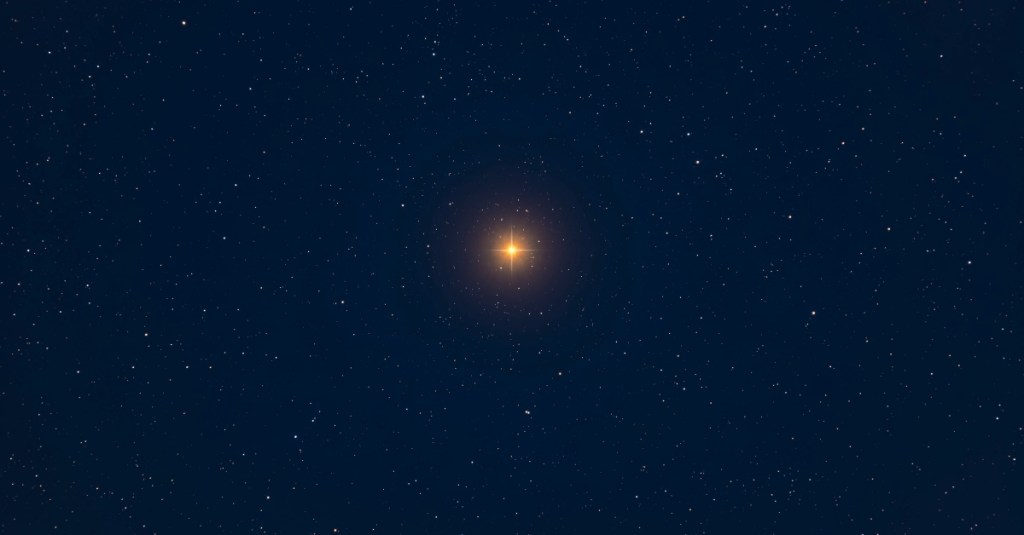
Astronomers have confirmed the existence of a hidden companion star orbiting the red supergiant Betelgeuse, shedding light on the star’s unusual brightness fluctuations. This discovery comes after nearly eight years of observations using the Hubble Space Telescope and ground-based observatories in Arizona and the Canary Islands.
Betelgeuse, located approximately 700 light-years from Earth, is known for its brightness variations, which have puzzled scientists. While its primary pulsation occurs roughly every 400 days, a second, longer cycle of about 2,100 days remained unexplained until now. This secondary cycle was too slow to be attributed to the typical internal processes that affect aging stars.
Researchers initially theorized that a dim companion star might be influencing Betelgeuse’s behavior. This theory has now been validated, revealing that Betelgeuse has had a companion star, named Siwarha, affecting its light emissions in subtle but significant ways.
New Insights into Stellar Behavior
The study’s lead author, Andrea K. Dupree, explained that Siwarha creates a “wake” of gas as it moves through the outer layers of Betelgeuse’s atmosphere. This phenomenon resembles a boat cutting through water, generating ripples that alter the star’s ultraviolet light emissions. Specifically, when Siwarha passes in front of Betelgeuse, astronomers observe a sharp spike in brightness due to the companion star’s interference with ionized iron emissions.
As Siwarha progresses along its orbit, it leaves behind a trail of gas that absorbs radiation, resulting in a noticeable reduction in brightness as the gas disperses. This pattern, repeating every 2,109 days, correlates directly with the previously mysterious long-term cycle, providing a comprehensive explanation for the fluctuations observed in Betelgeuse.
A Continued Observation Journey
According to NASA, this discovery marks a significant milestone in understanding stellar dynamics. “For the first time, we’re seeing direct signs of this wake, or trail of gas, confirming that Betelgeuse really does have a hidden companion shaping its appearance and behavior,” Dupree stated in an official release.
Siwarha is expected to remain behind Betelgeuse and will not be visible again until August 2027. During this time, astronomers will continue monitoring the ripples caused by the companion star, enhancing our knowledge of the intricate behaviors of massive stars.
This breakthrough not only enriches our understanding of Betelgeuse but also provides invaluable insights into the complex interactions between stars in our universe.

Security Guard Dies at 2026 Winter Olympics Construction Site

FDA Delays Stoke’s Request for Accelerated Approval of Epilepsy Drug

Last Survivor of 1925 Diphtheria Epidemic in Alaska Passes Away

Urgent Wildfires in Argentina Blaze Through 12,000 Hectares

Rising Prescription Costs Spark Outrage Among Patients

Rachel Campos-Duffy Exits FOX Noticias; Andrea Linares Steps In

Piper Rockelle Shatters Record with $2.3M First Day on OnlyFans

Meta’s 2026 AI Policy Sparks Outrage Over Privacy Concerns

Leon Goretzka Considers Barcelona Move as Transfer Window Approaches

Urgent Update: Denver Fire Forces Mass Evacuations, 100+ Firefighters Battling Blaze
-
Top Stories1 month ago
Rachel Campos-Duffy Exits FOX Noticias; Andrea Linares Steps In
-
Top Stories1 week ago
Piper Rockelle Shatters Record with $2.3M First Day on OnlyFans
-
Top Stories6 days ago
Meta’s 2026 AI Policy Sparks Outrage Over Privacy Concerns
-
Sports5 days ago
Leon Goretzka Considers Barcelona Move as Transfer Window Approaches
-
Top Stories1 week ago
Urgent Update: Denver Fire Forces Mass Evacuations, 100+ Firefighters Battling Blaze
-
 Top Stories1 week ago
OnlyFans Creator Lily Phillips Reconnects with Faith in Rebaptism
-
 Entertainment5 days ago
Tom Brady Signals Disinterest in Alix Earle Over Privacy Concerns
-
 Top Stories5 days ago
Warnock Joins Buddhist Monks on Urgent 2,300-Mile Peace Walk
-
 Top Stories7 days ago
Oregon Pilot and Three Niece Die in Arizona Helicopter Crash
-
 Health2 months ago
Terry Bradshaw Updates Fans on Health After Absence from FOX NFL Sunday
-
 Top Stories4 days ago
CBS Officially Renames Yellowstone Spin-off to Marshals
-
 Sports4 days ago
South Carolina Faces Arkansas in Key Women’s Basketball Clash