

Innovative Origami Wheel Set to Revolutionize Lunar Exploration

A research team led by Professor Dae-Young Lee from the Korea Advanced Institute of Science and Technology (KAIST) has developed a groundbreaking origami-inspired wheel designed for lunar exploration. This innovative technology aims to facilitate access to the Moon’s subterranean lava tubes and pits, which hold promise for future lunar bases. The wheel can expand and contract, addressing the challenges posed by the Moon’s rugged terrain and enabling small rovers to navigate obstacles that traditional wheels cannot.
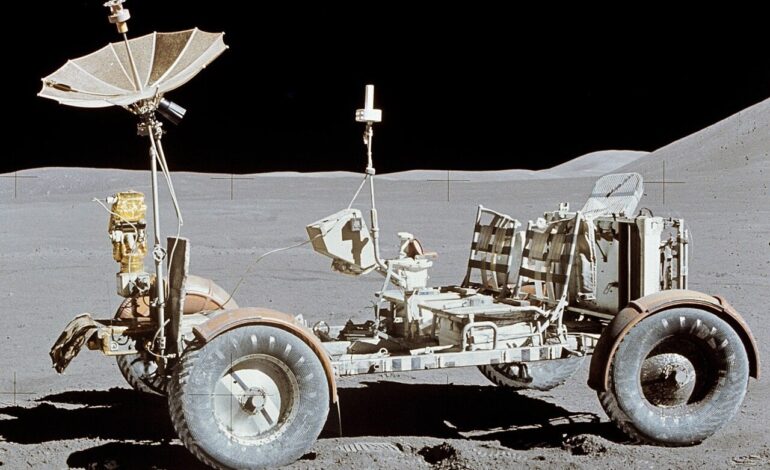
The Moon’s surface features a treacherous landscape, with steep and rocky entrances to natural caves that are crucial for future scientific missions. These underground structures offer protection from cosmic radiation and extreme temperature variations, making them ideal sites for potential human habitation. However, the existing small rovers, often deployed in swarms for exploration, struggle to traverse obstacles larger than their wheel diameter. In contrast, the newly developed wheels can expand from a compact 230 millimeters to 500 millimeters, significantly enhancing the climbing capabilities of small rovers.
Innovative Design Overcomes Harsh Lunar Environment
The lunar environment presents unique challenges for mechanical systems. Fine dust infiltrates machinery, while cold welding occurs between exposed metal surfaces in the airless vacuum of space. These factors contribute to the rapid deterioration of traditional hinges and joints. The research team found inspiration in the past, merging Leonardo da Vinci’s self-supporting bridge concepts with origami folding patterns. This approach eliminates the need for conventional mechanical joints, creating a wheel with an elastic metal frame and fabric tensioners that flex instead of pivot.
During testing, the wheel demonstrated exceptional traction on simulated lunar soil and survived impacts equivalent to a fall from 100 meters in lunar gravity. The design maintains a low profile during transport and offers the climbing ability of a larger vehicle once deployed. According to Dr. Chae Kyung Sim from the Korea Astronomy and Space Science Institute, this technology opens up opportunities to explore lunar pits, which are considered “natural geological heritages.”
Future Prospects for Lunar Exploration
Optimizing the wheel for the Moon’s extreme conditions was a critical focus of the research. Dr. Jongtae Jang from the Korea Aerospace Research Institute highlighted that thermal models were used to ensure the wheel can withstand temperature fluctuations of up to 300 degrees Celsius between lunar day and night. While challenges remain regarding communication and power systems, Professor Lee remains optimistic about the potential impact of this technology on future lunar missions.
The team’s development of the origami wheel positions them as potential leaders in lunar exploration, as interest in the Moon’s underground regions continues to grow. With this innovative solution, the next generation of lunar rovers could navigate the Moon’s enigmatic terrain with unprecedented ease, paving the way for scientific discoveries and the establishment of sustainable extraterrestrial habitats.