


Porsche Unveils Wireless EV Charging for Seamless Home Use
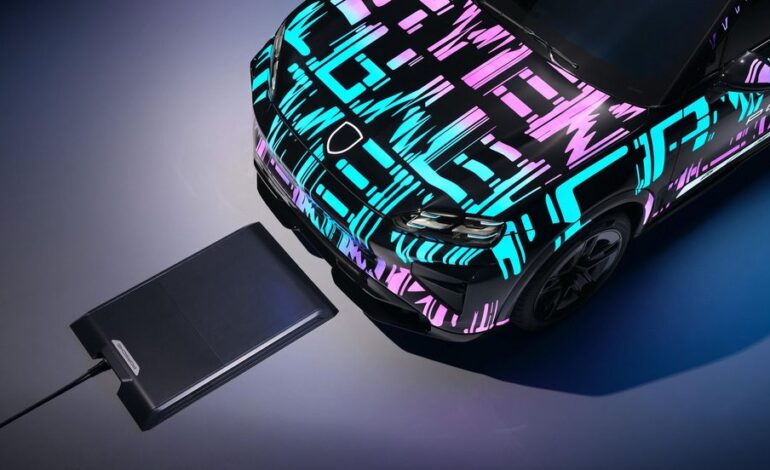

Porsche has introduced a groundbreaking wireless charging system for electric vehicles (EVs), set to debut with the upcoming Cayenne Electric in 2026. This innovative technology aims to eliminate the hassle of traditional charging methods, allowing drivers to charge their vehicles effortlessly without dealing with cumbersome cords. Demonstrated at the IAA Mobility show in Munich, the system is designed to enhance the overall ownership experience for EV users.
The wireless charging capability utilizes inductive technology, which has been in development for over a century. Unlike traditional charging methods that require physical connections, this system operates by using two coils of copper wire. A current flowing through one coil generates a magnetic field that induces voltage in the second coil. Porsche’s system includes a floor-mounted pad that connects to the home’s electrical panel, converting grid electricity into a high-frequency AC current. The resulting magnetic field can charge the Cayenne Electric efficiently, achieving around 90 percent efficiency even with a gap of 12 to 18 centimeters between the vehicle and the pad.
Porsche’s system allows users to charge their vehicles automatically by simply parking over the charging pad. The vehicle’s screen-based parking assist activates when the car is within 7.5 meters of the pad, guiding drivers to align their vehicle with an on-screen interface. Tolerances of 20 centimeters left to right and 15 centimeters fore and aft ensure that drivers can easily position their vehicles for charging.
Safety has been a primary focus in the development of this system. Christian Holler, head of charging systems at Porsche, stated that the technology conforms to standards set by the International Commission on Non-Ionizing Radiation Protection. The system operates within safe electromagnetic radiation levels, ensuring it is safe for all users, including those with pacemakers. Additionally, induction loops are in place to detect any objects between the charging pad and the vehicle, while radar sensors monitor for living beings nearby, halting charging if necessary.
The Cayenne Electric features an impressive 108-kilowatt-hour battery pack, allowing it to charge at public DC stations at a rate of up to 400 kW, achieving an 80 percent charge in approximately 16 minutes. When using the wireless system, drivers can expect Level 2 charging at home, providing about 11 kW of power. By parking over the pad, the vehicle can recharge from 10 to 80 percent in around 7.5 hours, without the need for plugs or cords.
Despite the excitement surrounding this technology, the high cost may limit initial adoption. In Europe, buyers will pay around €7,000 (approximately US $8,100) for the optional charger, with pricing for the U.S. market yet to be confirmed. According to Loren McDonald, chief executive of Chargeonomics, wireless charging is the future, particularly for applications like driverless robotaxis or curbside charging. However, the current high costs associated with inductive charging may restrict its implementation to niche markets and affluent consumers.
Porsche recognizes the importance of broader adoption for the success of this technology. The system is designed to conform to wireless standards established by the Society of Automotive Engineers, allowing other automakers to utilize the technology. Simon Schulze, Porsche’s product manager for charging hardware, emphasized the company’s intent to create a solution that benefits the entire automotive industry, rather than being exclusive to Porsche.
As the automotive world shifts towards electrification, Porsche’s wireless charging system represents a significant step forward in making EV ownership more convenient and accessible. By addressing the challenges associated with traditional charging methods, Porsche aims to enhance the driving experience for its customers while promoting the widespread adoption of electric vehicles.