
USC’s Lincoln Riley Blasts Notre Dame for Ending Historic Rivalry
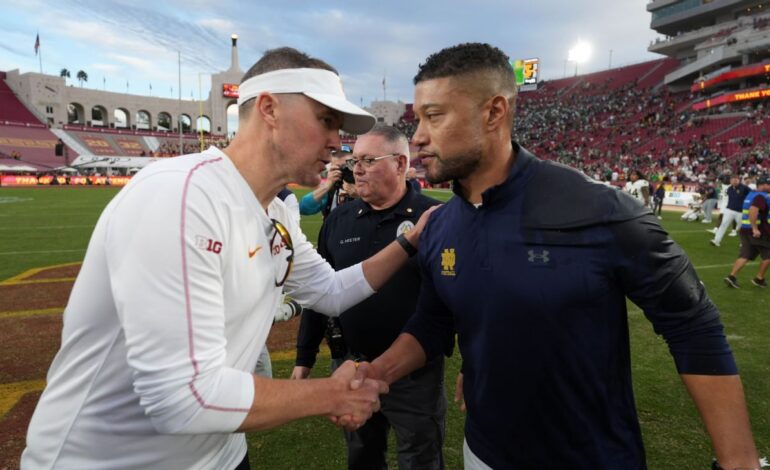

BREAKING: USC coach Lincoln Riley has publicly criticized Notre Dame for abruptly ending the historic football rivalry, citing their failure to honor a commitment to play “anytime, anywhere.” In a press conference on December 29, 2025, in San Antonio ahead of the Valero Alamo Bowl, Riley revealed that Notre Dame swiftly rejected USC’s proposal for games in 2026 and 2027, thus halting a series that has spanned nearly a century since 1926.
Riley’s frustration is palpable as he explained that USC spent months negotiating to keep the series alive. “We took Notre Dame at their word that they would play us anytime and anywhere,” he stated. “That proposal was rejected. Not only was it rejected, five minutes after we got the call, it was announced that they had scheduled another opponent [BYU].” This quick scheduling turnaround has been dubbed the fastest in college football history.
The rivalry, which has seen 96 matchups since its inception, has typically been played in mid-to-late October at Notre Dame or at the end of the regular season at USC. However, due to Notre Dame’s recent addition of a home-and-home series with BYU, the Irish have filled their schedule for the next two years, leaving the future of the USC rivalry in jeopardy.
In a joint statement, both schools indicated they would “continue working toward bringing back” the rivalry, but any resumption is unlikely before 2030 at the earliest. Riley lamented, “Had Notre Dame lived up to their word and played us anytime, anywhere, we would be playing in the next two years.”
Adding to the stakes, Riley has faced defeat against Notre Dame in his last three matchups, a tough pill to swallow after winning in his debut season at USC. He acknowledged that Notre Dame’s status as an independent allows for greater scheduling flexibility, a luxury that USC, now a member of the Big Ten, does not enjoy.
USC athletic director Jen Cohen previously expressed concerns over the scheduling challenges, noting, “Intentionally making our road to the CFP significantly more difficult than our Big Ten peers does not align with our goal to win championships.” USC has never qualified for the College Football Playoff (CFP), increasing the urgency of their scheduling decisions.
Despite the setback, Riley remains hopeful for the future of the rivalry. “We at USC would love for the game to continue,” he said. “We have no problem following through on our promises in the future.”
This developing story continues to capture the attention of college football fans, with the implications of this rivalry’s halt resonating across the sport. As both teams navigate their schedules, the anticipation builds for potential future matchups that could revive one of college football’s most storied rivalries.