


US Announces $2 Billion Aid Pledge Amid Major Cuts to Foreign Assistance

The United States has pledged $2 billion in humanitarian aid to the United Nations, a commitment that reflects the ongoing policies of the Trump administration to reduce foreign assistance. This announcement, made on Monday, underscores a significant shift in U.S. aid strategy, emphasizing a need for reform within the U.N. and its affiliated agencies.
The $2 billion pledge is a notable reduction compared to previous years, where U.S. contributions to U.N. humanitarian efforts reached as high as $17 billion annually. Officials indicate that only $8-$10 billion of this amount has historically been provided through voluntary contributions. In light of these changes, the U.S. administration aims to maintain its position as the largest humanitarian donor while pushing for significant reforms within the U.N. system.
Implications for Global Humanitarian Efforts
This funding will create an umbrella fund managed by the U.N. Office for the Coordination of Humanitarian Affairs (OCHA), led by Tom Fletcher, a former British diplomat. The U.S. seeks to streamline aid distribution through this office, prioritizing efficiency and accountability in how humanitarian funds are allocated.
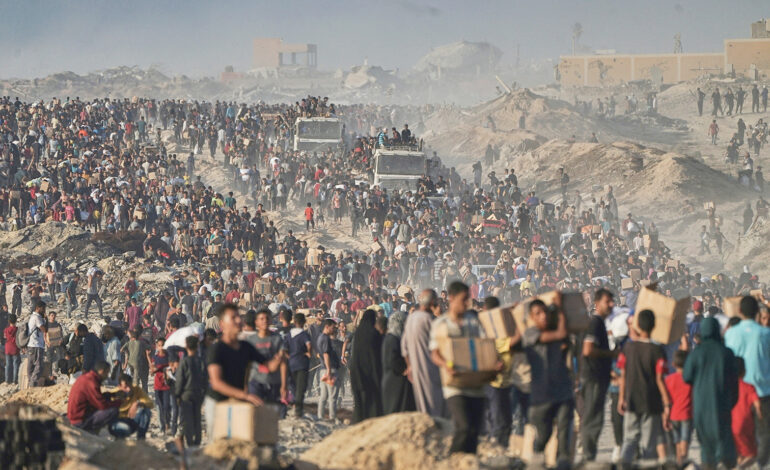
Critics, however, express concern that these cuts will exacerbate global crises, with millions facing hunger, displacement, and disease. The need for aid is particularly acute in regions such as Sudan and Gaza, where recent famine conditions have been reported.
The Trump administration has already cut billions in foreign aid, leading to widespread reductions in programs and job losses within key U.N. agencies, including the World Food Program and the U.N. High Commissioner for Refugees (UNHCR). This year’s pledge indicates a continuation of this trend, as U.S. contributions have significantly declined compared to previous allocations under both the Biden administration and the earlier years of Trump’s presidency.
Strategic Shift in U.S. Aid Policy
A senior State Department official emphasized the need for “more consolidated leadership authority” in U.N. aid delivery systems. Under the new plan, OCHA will control distribution to ensure that funds are directed more strategically, aligning with U.S. foreign policy objectives.
U.S. Ambassador to the United Nations Michael Waltz stated, “This humanitarian reset at the United Nations should deliver more aid with fewer tax dollars,” highlighting the administration’s focus on results-driven assistance. The $2 billion is intended as an initial contribution to support OCHA’s annual appeal for funds, which has already been reduced this year.
The agreement requires the U.N. to consolidate its humanitarian functions to mitigate bureaucratic inefficiencies and eliminate duplicative efforts. This directive may lead to significant changes in the operational dynamics of U.N. agencies, compelling them to adapt, shrink, or face potential closure.
One of the key aspects of this reform initiative is the targeted establishment of funding pools for specific crises or regions, with 17 countries identified for initial support, including Bangladesh, Congo, Haiti, Syria, and Ukraine. Notably, Afghanistan and the Palestinian territories are excluded from this funding initiative, with U.S. officials indicating that assistance for these areas will be addressed through other channels.
The U.S. administration’s approach reflects a long-standing belief that while the U.N. has the potential to be a powerful force for good, it has strayed from its core mission of saving lives and has become mired in inefficiencies and mismanagement.
In response to the announcement, Tom Fletcher commented on the importance of the U.S. role in global humanitarian efforts, stating, “At a moment of immense global strain, the United States is demonstrating that it is a humanitarian superpower, offering hope to people who have lost everything.”
As the international community grapples with escalating humanitarian needs, the implications of the U.S. aid cuts will likely resonate across various sectors, challenging both U.N. agencies and recipient nations to navigate a changing landscape of support.