


Major Space Missions Set to Transform Exploration in 2026

As 2026 approaches, a series of ambitious space missions promise to reshape our understanding of the solar system and enhance human presence in space. With initiatives from both governmental and private sectors, the year is expected to witness significant advancements in space exploration, including crewed lunar missions, asteroid sample returns, and the launch of cutting-edge telescopes.
The landscape of space exploration is rapidly evolving, with key milestones planned across an array of missions. Here are some of the standout projects to watch in 2026.
NASA’s Artemis 2: A New Era of Lunar Exploration
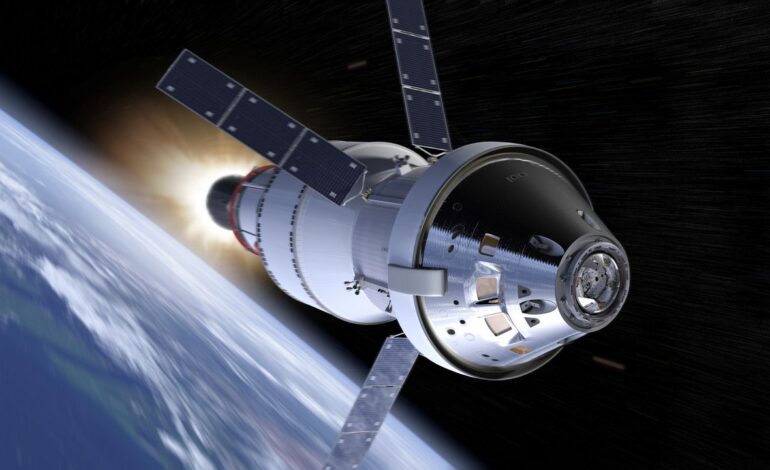
NASA’s Artemis 2 mission is set to carry four astronauts on a historic journey around the moon, scheduled for launch no earlier than February 5, 2026. This mission marks humanity’s first crewed venture beyond low Earth orbit since Apollo 17 in 1972. The crew, which includes NASA astronauts Reid Wiseman (commander), Victor Glover (pilot), Christina Koch (mission specialist), and Jeremy Hansen from the Canadian Space Agency, will spend approximately ten days testing life-support systems and navigation capabilities aboard the Orion spacecraft.
Artemis 2 serves as a crucial testing ground for future lunar landings, including the anticipated Artemis 3 mission, aimed at returning humans to the lunar surface.
SpaceX and the Future of Interplanetary Travel
In 2026, SpaceX aims to achieve significant milestones with its Starship vehicle. The company plans to conduct its first orbital flight and demonstrate in-orbit cryogenic propellant transfer, a key capability for deep-space missions. While Elon Musk has suggested a potential Mars launch in the same year, he acknowledges the challenges, stating the odds are about “50–50.” Achieving successful orbital operations and rapid reuse of Starship components could mark a pivotal year for interplanetary exploration.
Another notable mission from SpaceX includes the launch of the world’s first commercial space station, Haven-1, scheduled for no earlier than May 2026. This station, developed by Vast Space, aims to host short-duration crewed missions and support various research and commercial activities.
China’s Ambitious Lunar and Asteroid Missions
China is set to make waves in 2026 with multiple missions. The Tianwen-2 spacecraft is expected to arrive at the near-Earth asteroid Kamoʻoalewa in July 2026, aiming to collect surface samples that may provide insights into the early solar system. This mission is particularly significant as some researchers speculate the asteroid could be a fragment of the moon.
Additionally, China’s Chang’e 7 mission is planned for mid- to late 2026, targeting the moon’s south pole, where water ice is believed to exist. This mission will deploy a combination of an orbiter, lander, and rover to explore the lunar surface and assess resources.
Innovative Developments in Spacecraft Technology
Several innovative spacecraft are scheduled for launch in 2026. Boeing’s Starliner-1 mission to the International Space Station (ISS) will focus on validating upgrades and delivering cargo, with a launch targeted for no earlier than April 2026. This uncrewed mission is vital for establishing Starliner as a reliable crew vehicle alongside SpaceX’s Crew Dragon.
Meanwhile, Rocket Lab is set to debut its Neutron rocket in mid-2026, expanding its capabilities beyond small-satellite launches. This partially reusable rocket is designed for heavy-lift missions, marking Rocket Lab’s entry into a competitive sector.
Groundbreaking Observations with Next-Generation Telescopes
The year will also witness the launch of advanced observatories. China’s Xuntian space telescope is scheduled for launch in late 2026, featuring a primary mirror that rivals the Hubble Space Telescope. This observatory aims to conduct wide-field surveys and support studies in cosmology and dark matter.
NASA’s Nancy Grace Roman Space Telescope is expected to launch in the fall of 2026, boasting a field of view approximately 100 times larger than Hubble’s. Its mission will focus on dark energy studies and discovering exoplanets through gravitational microlensing.
Conclusion: A Pivotal Year for Space Exploration
As these missions unfold, 2026 is poised to be a transformative year in space exploration. With advancements in technology, international collaboration, and a renewed focus on lunar and interplanetary missions, humanity stands at the brink of a new age of discovery. These efforts not only enhance our understanding of the solar system but also pave the way for future generations to thrive in space.