

Stunning Image Reveals Collision of Dwarf Galaxies 24 Million Light-Years Away
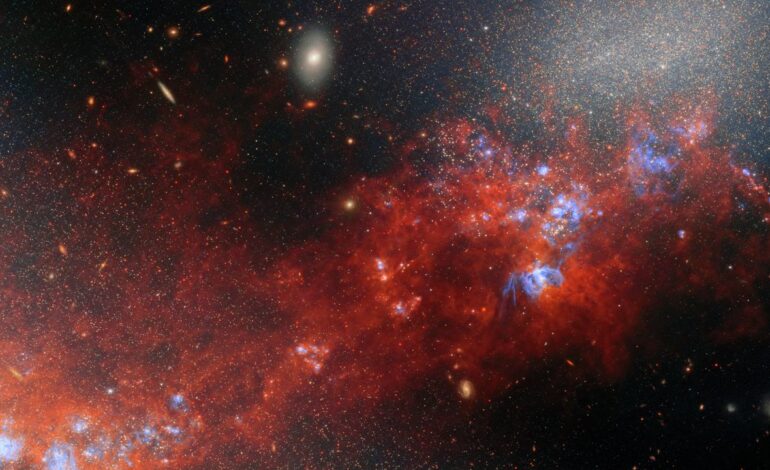

A breathtaking new image from the James Webb Space Telescope showcases a cosmic collision between two dwarf galaxies, revealing a luminous gas bridge and streams of newly formed stars. This striking view captures the gravitational interaction between the dwarf galaxies NGC 4490 and NGC 4485, located approximately 24 million light-years from Earth.
The image highlights the larger galaxy, NGC 4490, which dominates the left side of the frame with its intricate structure of dust and glowing stars. Meanwhile, its smaller counterpart, NGC 4485, can be seen glowing in the upper right corner. The two galaxies are connected by a bright bridge of gas and dust, which is interspersed with clusters of young stars that appear blue against the backdrop of warm, reddish interstellar dust. This interaction has triggered a wave of star formation, providing vital insights into the processes that shape galaxies.
According to a statement from the European Space Agency (ESA), these dwarf galaxies offer a unique opportunity to study the conditions that existed in the early universe. The collisions and exchanges of gas within these systems resemble the low-mass, gas-rich, and metal-poor galaxies that were prevalent billions of years ago.
Unprecedented Detail from Webb’s Infrared Vision
While the galactic pair, collectively known as Arp 269, has been the subject of previous observations from the Hubble Space Telescope, the new data from Webb’s advanced infrared instruments provides an unprecedented level of detail. Utilizing the Near-Infrared Camera (NIRCam) and the Mid-Infrared Instrument (MIRI), astronomers can now examine individual stars and the intricate structure of the gas flowing between the galaxies.
ESA officials noted that this detailed analysis allows researchers to identify the locations of young, middle-aged, and older stars, effectively mapping out the timeline of the galaxies’ interaction. The findings suggest that NGC 4490 and NGC 4485 passed close to each other around 200 million years ago. During this encounter, NGC 4490 extracted gas from its smaller neighbor, forming the visible bridge of materials that fuels ongoing star formation. Notably, some of this star formation has occurred as recently as 30 million years ago.
Insights into Galactic Evolution
The observations made by the James Webb Space Telescope have enriched our understanding of how dwarf galaxies interact and evolve. “By capturing the history of the galactic dancers NGC 4490 and NGC 4485, Webb has revealed new details in how dwarf galaxies interact, giving us a glimpse of how small galaxies near and far grow and evolve,” ESA officials stated.
This research not only enhances our knowledge of specific galactic interactions but also contributes to the broader understanding of galaxy formation and evolution throughout the universe’s history. As astronomers continue to study these dwarf galaxies, they hope to uncover further insights into the early universe and the fundamental processes that led to the formation of larger galaxies like our own Milky Way.