

Stargazers Prepare for the Last Supermoon of 2025 on December 4
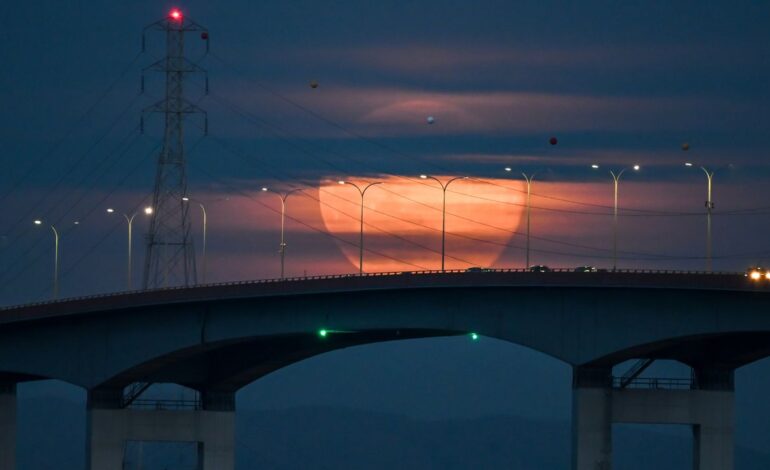

The final full moon of 2025, known as the **Cold Supermoon**, will illuminate the night sky on **December 4**. This celestial event occurs at **8:13 p.m. EST** (2313 UTC), when the moon reaches its full phase, appearing bright and fully illuminated opposite the sun and rising prominently above the eastern horizon.
Often referred to as the **Cold Moon**, this full moon gets its name from the chilly temperatures typical of this time of year. It is also called the **Long Night Moon**, reflecting the extended nights and shorter days as the northern hemisphere transitions towards winter. On this occasion, the moon will be particularly noteworthy, as it will be within **90% of perigee**, the point in its orbit closest to Earth, resulting in a striking “supermoon.” This proximity allows the moon to appear up to **14% larger** and **30% brighter** than the smallest full moon of the year.
What to Expect from the Cold Supermoon
Skywatchers in the United States will have an exceptional view as the moon rises at sunset on December 4. Its brightness will overshadow nearby stars, including those in the **Taurus** constellation and the **Pleiades** star cluster. This visibility makes the Cold Supermoon an exciting event for both amateur and experienced astronomers.
For those looking to enhance their viewing experience, the **Celestron NexStar 8SE** telescope is highly recommended. Although it comes with a higher price tag, many enthusiasts find it offers excellent value for observing celestial events.
As the moon ascends, it may take on a distinctive yellow-orange hue, a result of **Rayleigh scattering**. This phenomenon occurs as Earth’s atmosphere scatters shorter blue wavelengths of sunlight, giving the moon a warmer color when it is closer to the horizon. Additionally, the “moon illusion” may make the lunar disk appear larger than it is when viewed near the horizon, compared to when it is overhead.
On December 4, the full moon will also ride higher in the sky than it has in recent months. This adjustment is due to the shallower path of the sun as the winter solstice approaches on **December 21**.
Exploring the Moon’s Surface
For those interested in observing details of the moon’s surface, the **lunar maria**—vast basaltic plains formed by ancient volcanic activity—can be seen with the naked eye. A small telescope will allow viewers to spot larger craters and mountain ranges on the moon’s surface.
Those eager to capture the beauty of the Cold Supermoon are encouraged to consider the best binoculars and telescopes for stargazing. Additionally, photography enthusiasts can explore options for cameras and lenses that are ideal for documenting this significant astronomical event.
As the Cold Supermoon approaches, those interested in sharing their photos can send submissions, including name and location, to **[email protected]**. This event promises to be a memorable conclusion to the lunar calendar for 2025, inviting stargazers to experience the wonder of the night sky.