


Scientists Discover Ancient Bird Choked on 800 Stones
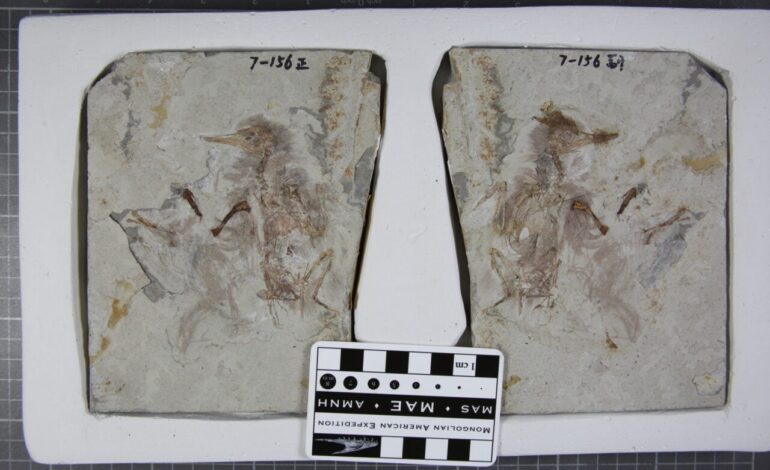

A remarkable paleontological discovery has revealed that a bird named Chromeornis funkyi choked to death approximately 120 million years ago after swallowing over 800 tiny stones. Researchers at the Field Museum in Chicago made this unusual finding while examining fossil collections at the Shandong Tianyu Museum of Nature in China. The fossil represents a new species, leading to its quirky name, the “Funky Chromeo bird,” in homage to the electro-funk band.
The team, led by curator Jingmai O’Connor, first noticed the fossil’s unique characteristics during a routine examination of bird fossils. O’Connor described the initial encounter with the fossil as striking, noting similarities to a larger bird species called Longipteryx. “It had really big teeth at the end of its beak, just like Longipteryx, but it’s a tiny little guy,” she remarked, indicating the fossil’s unexpected features.
Upon closer inspection using a microscope, researchers discovered an “unusual mass of stones” lodged in the bird’s esophagus, positioned right against its neck bones. Subsequent chemical analyses confirmed that these stones were indeed swallowed rather than simply accumulated during the fossilization process. While it is known that some bird species, such as owls and chickens, consume stones to aid digestion in a muscular organ called the gizzard, none of the thousands of fossilized birds in the same group as Chromeornis had previously been found with such stones.
The research team considered the possibility that this bird might be the first of its kind known to have gizzard stones. To explore this, they compared the characteristics of the stones found in Chromeornis with those of known gizzard stones in other fossilized birds. A CT scan of the fossil revealed over 800 tiny stones in its throat, significantly more than typically observed in birds that use gizzards for digestion. Interestingly, some of these stones were identified as small clay balls, suggesting they did not serve any digestive purpose.
This led the researchers to consider another hypothesis: could the bird have been ill? O’Connor explained that sick birds often exhibit unusual behaviors, potentially leading to such a tragic outcome. “It swallowed too many, and it tried to regurgitate them in one big mass. But the mass of stones was too big, and it got lodged in the esophagus,” she stated.
While this discovery sheds light on the life and death of Chromeornis funkyi, it is essential to approach paleontological findings with caution. Interpretations of fossils can vary, and follow-up studies may provide further insights into this peculiar case. As O’Connor noted, the broader paleontological community will likely engage in further analyses to understand this extraordinary specimen and its demise better.
The story of Chromeornis also serves as a reminder of the broader themes of extinction and survival among prehistoric birds. Birds belonging to the same group as Chromeornis were thought to be among the most numerous in the final eras of the dinosaurs. However, the catastrophic asteroid impact around 66 million years ago led to the extinction of all non-avian dinosaurs, leaving behind only those birds that have evolved into the species we see today.
Understanding the factors that contributed to the survival of certain bird species while others became extinct offers critical insights into current conservation efforts. “Learning about Chromeornis and other birds that went extinct could ultimately help guide conservation efforts today,” O’Connor concluded.
The findings will be detailed in an upcoming paper in Palaeontologia Electronica, further contributing to our understanding of avian history and the complexities surrounding survival in prehistoric ecosystems.