
Robots Revolutionize Battlefield Triage at DARPA Challenge
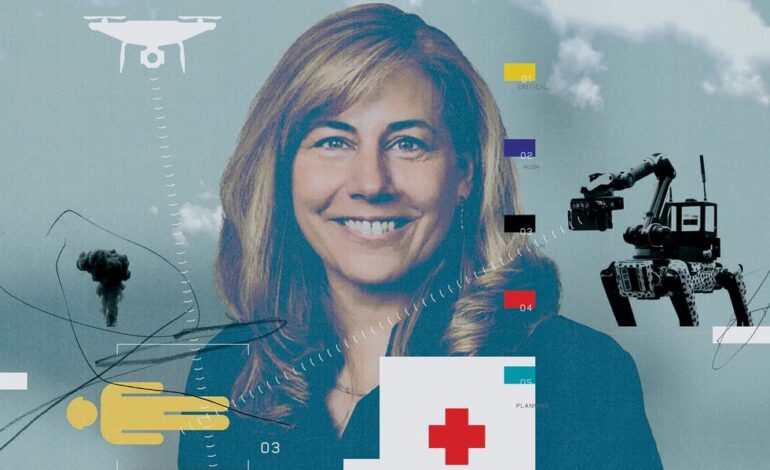

The Defense Advanced Research Projects Agency (DARPA) is testing innovative robotic technology aimed at enhancing triage in mass-casualty situations. Last September, teams of robots were deployed in simulated scenarios such as an airplane crash and a nighttime ambush. Their primary objective is to locate victims and assess the severity of their injuries, ultimately aiding human medics in prioritizing care effectively. The final event of the DARPA Triage Challenge is scheduled for November 2023, with Team Chiron from Carnegie Mellon University set to participate.
Led by Kimberly Elenberg, a veteran with 28 years of experience as an army and U.S. Public Health Service nurse, Team Chiron is utilizing a combination of quadruped robots and drones. Elenberg emphasizes the necessity of robotic assistance in triage, stating that the current number of responders is insufficient for handling mass-casualty incidents. She notes, “We need the perspective that we need to identify where people are, assess who’s most at risk, and figure out how responders can get to them most efficiently.”
The deployment of these robots could have proven invaluable during a recent incident Elenberg encountered. While en route to one of the challenge events, she witnessed a four-car accident. Despite her efforts to assist, she realized the limitations of human responders in chaotic situations. “I could hear some people yelling and see others walking around,” she recounted. “In the fourth car, I had to crawl inside to reach a gentleman who was slumped over with an occluded airway.” This experience highlighted the potential for robots to gather critical data in situations where human responders may struggle, such as detecting heart rates from changes in skin color or monitoring breathing from a distance.
The technology being developed focuses on simplicity for field use. Elenberg describes a vest-mounted Android phone that displays a map with real-time GPS locations of casualties and their triage priorities. The information is autonomously populated by the team of robots, allowing medics to maintain their focus on patients.
When questioned about the capabilities of the robots, Elenberg emphasized the importance of rigorous testing. “The only way to understand true capability is to build it, test it, and break it,” she stated. Her experience in service has shown her that integrating sensing, communications, and autonomy is crucial for success. “While the technology still has limitations, the pace of progress is extraordinary.”
For Elenberg, success is already evident in the advancements made. “Showing responders exactly where casualties are and estimating who needs attention most—that’s a huge step forward for disaster medicine.” Looking ahead, she is optimistic about the future milestones in robotic triage, such as recognizing specific injury patterns and identifying necessary life-saving interventions.
As the final event of the DARPA Triage Challenge approaches, the potential for robots to transform triage processes on the battlefield appears promising. With continued development, these technologies may significantly enhance the effectiveness and efficiency of emergency response efforts in real-world scenarios.