

Nancy Grace Roman Space Telescope Set to Revolutionize Exoplanet Discovery

The upcoming launch of the Nancy Grace Roman Space Telescope promises to significantly enhance the field of exoplanet discovery. Scheduled for deployment in 2025, this innovative telescope aims to broaden the scope of gravitational microlensing surveys, allowing for the detection of more events with heightened precision. Researchers are particularly excited about the telescope’s capabilities in identifying triple-lens microlensing systems, where a star with two orbiting exoplanets generates detectable anomalies during microlensing events.
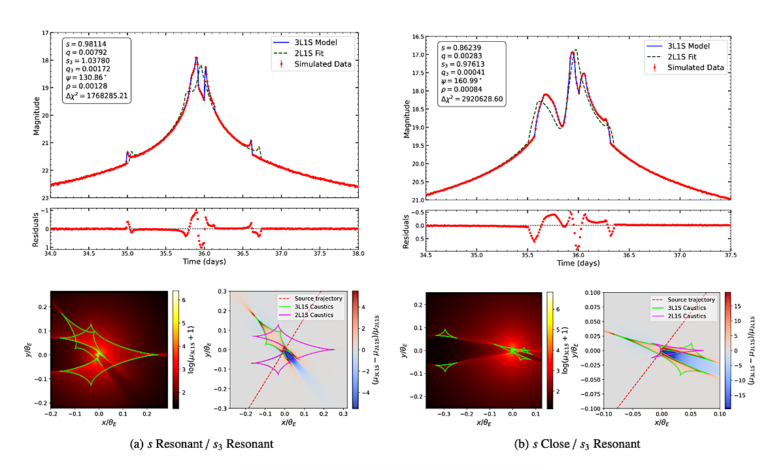
The telescope will focus its high-cadence observations on the Galactic bulge, an area dense with stars, to maximize its chances of detecting these anomalies. A recent study conducted by a team led by Vito Saggese explored the instrument’s ability to discern between single-planet and two-planet systems during microlensing events. By simulating a large dataset of high-magnification microlensing light curves, the researchers established criteria to reliably identify secondary planets.
Results from their simulations indicate that the majority of detectable two-planet microlensing events will be within the telescope’s reach. Specifically, events involving two relatively massive planets, characterized by planet-star mass ratios around 10-3, exhibit strong central perturbations in light curves. These perturbations lead to detection efficiencies of approximately 90%. In contrast, systems with low-mass planets, with ratios closer to 10-4, or those with less favorable alignments, tend to generate weaker signals. Such signals often fall below the detection threshold, complicating their identification.
The study also delves into the significance of planetary mass ratios and the resulting caustic geometry. The size of central caustics, influenced by the planets’ orbits—whether resonant or wide/close—emerges as a crucial factor in determining detectability. When considering the expected frequency of planetary systems and the rate of high-magnification events, the researchers estimate that the Nancy Grace Roman Space Telescope will likely detect a high-magnification triple-lens event in about 4.5% of multi-planet microlensing events. This projection corresponds to an estimated total of 64 events throughout the full duration of the survey.
The implications of these findings are substantial for the field of astrophysics. With the potential to unveil new planetary systems, the Nancy Grace Roman Space Telescope could provide invaluable insights into the formation and distribution of exoplanets in our galaxy. This research, published in a detailed paper, represents a collaborative effort by prominent scientists including Étienne Bachelet, David P. Bennett, and several others, all of whom contributed to refining the detection methods and enhancing the overall understanding of microlensing phenomena.
As anticipation builds around the launch of this groundbreaking telescope, the scientific community looks forward to the transformative discoveries it may usher in regarding planetary systems beyond our own. The advancements made possible by the Nancy Grace Roman Space Telescope could redefine our understanding of the cosmos and our place within it.