

Honeybees Impact Bumblebee Behavior in Ireland’s Heathlands
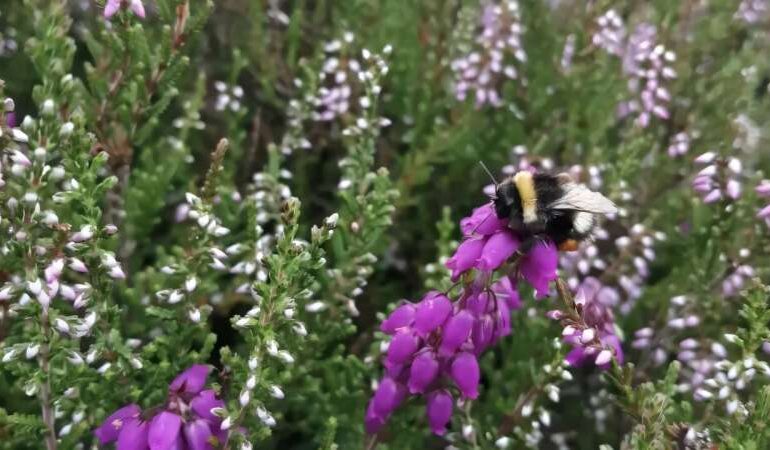

Research from an Irish-Swedish team has revealed that the introduction of honeybees into Ireland’s Wicklow Mountains significantly affects wild bumblebees. The study, published on December 10, 2025, in the journal Proceedings of the Royal Society B: Biological Sciences, highlights how the presence of honeybees alters bumblebee behavior and even impacts their size.
During the late summer, the slopes of the Wicklow Mountains bloom with vibrant heather, attracting beekeepers seeking to harvest the region’s renowned heather honey. However, as honeybees are introduced to the flower-rich heathlands, their competition appears to have negative consequences for the local bumblebee population.
Lina Herbertsson, a biology researcher at Lund University, led the study, which tracked bumblebee movement across sites with varying numbers of beehives—ranging from zero to thirty-five. The research team observed that bumblebees altered their foraging behavior, spending less time on heather flowers when honeybees were present.
The findings indicate that bumblebees moved on more quickly, which suggests that the heather flowers contained less nectar and pollen than usual. Surprisingly, the bumblebees in areas with higher honeybee populations were also smaller in size. The researchers theorized that larger bumblebees, typically able to forage farther from their nests, may have relocated to areas with fewer honeybees. Meanwhile, smaller bumblebees, which usually tend to the brood, may have taken on additional foraging responsibilities when larger bumblebees could not keep pace.
“This is unexpected in places that are rich in flowers,” said Herbertsson. “The impact was noticeable both near the beehives and up to a kilometer away.”
The implications of this research extend beyond Ireland’s borders. Honeybees, bumblebees, and other wild pollinators play critical roles in the pollination of plants, fruits, and crops. Currently, wild pollinators face challenges due to habitat loss, and the increase in honeybee populations adds another layer of complexity to their survival.
Beekeeping is a time-honored cultural tradition and an essential element of food production. Therefore, finding a balance between the needs of honeybees and wild bumblebees is crucial for environmental health and food security.
Herbertsson emphasized the importance of the study’s findings: “We hope our results can assist beekeepers and conservation biologists in planning the placement of beehives. Our ultimate goal is to ensure the survival of all pollinators, which is vital for both agriculture and the health of wild ecosystems.”
For more details, refer to the research article “Honeybees have consequences for foraging bumblebees in Irish heathlands,” available in the Proceedings of the Royal Society B: Biological Sciences. The study highlights the need for further exploration of how honeybee populations can coexist with wild pollinators to promote a healthy ecosystem.