
Science
Catch Mercury in the Evening Sky: Viewing Tips for February

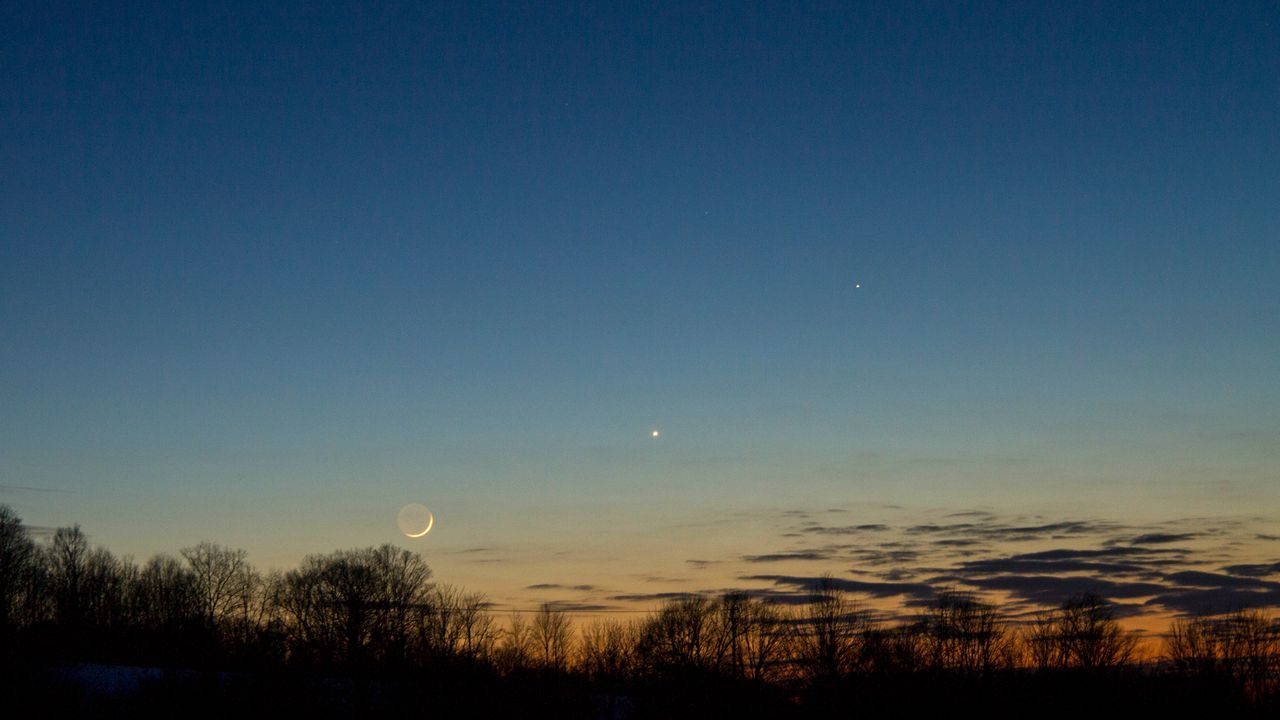
Amateur astronomers and skywatchers will soon have a prime opportunity to view Mercury, the smallest and innermost planet in the solar system. From **February 6, 2026**, Mercury will shine brightly in the evening sky, making it accessible for viewers, especially in the mid-northern latitudes. This period marks the best evening appearance of Mercury for the year, offering a chance to spot the elusive planet.
The viewing conditions for Mercury will be optimal around this time, as it will be positioned just above the sun’s location in the sky. Observers can expect to see this planet shining at a magnitude of **-1.1**, comparable to the brightness of **Sirius**, the brightest star. Although it will initially set only about **55 minutes** after the sun, it will gradually rise higher in the sky over the following evenings.
Key Viewing Dates and Conditions
By **February 19, 2026**, Mercury will reach its greatest elongation, standing **18 degrees** from the sun. For viewers near **latitude 40 degrees north**, this means that Mercury will be nearly **17 degrees** above the horizon at sunset, remaining visible well into the darkening twilight. On this evening, it will shine at a magnitude of **-0.4**, brighter than **Arcturus**, making it an excellent target for both casual observers and seasoned astronomers.
An exciting highlight will occur on **February 18**, when Mercury will share the sky with a slender waxing crescent moon. Just **45 minutes** after sunset, observers can look low toward the west-southwest to find the moon, which will be only **2 percent** illuminated. Positioned directly above the moon, Mercury will appear as a bright “star,” creating a striking celestial tableau. Residents in states such as **Texas, Arkansas, Louisiana, Mississippi, Alabama, Georgia**, and **Florida** may even witness the moon passing in front of Mercury around **19:37 EST**/**18:37 CST**, a spectacle enhanced by binoculars.
Mercury’s Phases and Visibility
As the month progresses, Mercury will undergo noticeable changes in brightness and appearance. At the start of February, its disk will be **97 percent** illuminated, giving it a bright appearance. However, by the time it reaches its greatest elongation, the illumination will decrease to **50 percent**, resulting in a dramatic drop in brightness. On **February 24**, Mercury’s magnitude will drop to **+0.6**, and by **February 26**, it is expected to fade further to **+1.3**, making it increasingly difficult to spot against the bright twilight.
As Mercury descends lower in the evening sky, it will eventually become obscured by the sun’s glare, marking the end of its evening visibility. It will pass through inferior conjunction—positioned between the sun and the Earth—on **March 7**, concluding its run in the evening sky.
In summary, the upcoming weeks present a unique opportunity for skywatchers to connect with the cosmos through the observation of Mercury. With the right conditions and timing, this elusive planet can be easily spotted, promising an engaging experience in the night sky.

Nevada GOP Rep. Mark Amodei Announces Retirement, Seats at Risk
Simplify Your Windows 11 Experience: Remove These 7 Features

TKO Group Announces Six to Seven Fights at White House Event

Sydney Sweeney Launches Syrn Lingerie with Stunning New Look

UW–Madison and GE HealthCare Win Award for Innovative Partnership

Jayda Cheaves Claims Lil Baby and Ari Fletcher Had an Affair

Rachel Campos-Duffy Exits FOX Noticias; Andrea Linares Steps In

Piper Rockelle Shatters Record with $2.3M First Day on OnlyFans

Harvard Physicist Proposes Cosmic Location for Heaven at 273 Billion Trillion Miles

Terry Bradshaw Updates Fans on Health After Absence from FOX NFL Sunday
-
Entertainment3 weeks ago
Jayda Cheaves Claims Lil Baby and Ari Fletcher Had an Affair
-
Top Stories2 months ago
Rachel Campos-Duffy Exits FOX Noticias; Andrea Linares Steps In
-
Top Stories1 month ago
Piper Rockelle Shatters Record with $2.3M First Day on OnlyFans
-
Science2 weeks ago
Harvard Physicist Proposes Cosmic Location for Heaven at 273 Billion Trillion Miles
-
Health3 months ago
Terry Bradshaw Updates Fans on Health After Absence from FOX NFL Sunday
-
 Top Stories1 month ago
Meta’s 2026 AI Policy Sparks Outrage Over Privacy Concerns
-
 Sports1 month ago
Leon Goretzka Considers Barcelona Move as Transfer Window Approaches
-
 Top Stories1 month ago
Urgent Update: Denver Fire Forces Mass Evacuations, 100+ Firefighters Battling Blaze
-
 Top Stories1 month ago
OnlyFans Creator Lily Phillips Reconnects with Faith in Rebaptism
-
 Top Stories3 weeks ago
Patriots Face Altitude Challenge in AFC Championship; Experts Weigh In
-
 Top Stories1 month ago
Oregon Pilot and Three Niece Die in Arizona Helicopter Crash
-
 Sports4 weeks ago
South Carolina Faces Arkansas in Key Women’s Basketball Clash