

Astronomers Investigate Axions Using White Dwarfs and Hubble Data
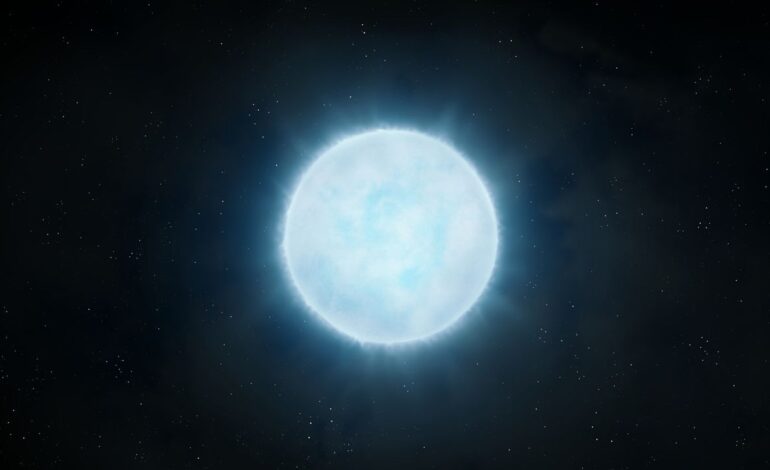

Research into the elusive axion, a theoretical particle linked to dark matter, has taken a significant step forward as astronomers examine the cooling rates of white dwarfs. These dense remnants of stars, significantly smaller than Earth yet possessing the mass of the Sun, may hold clues to understanding axions and their potential role in the universe’s composition.
The axion was originally proposed decades ago to address issues related to the strong nuclear force. Initial attempts to detect it in particle collider experiments yielded no results, causing the concept to fade from the spotlight. Recently, however, renewed interest has emerged as theorists suggested that axions could account for dark matter’s mysterious nature. Despite being nearly invisible, axions may influence cosmic phenomena in detectable ways.
In a pre-print paper published in November 2025 on the open-access server arXiv, researchers devised a method to test axion models using archival data from the Hubble Space Telescope. This innovative approach, though it did not confirm the existence of axions, provided a clearer understanding of their potential interactions with matter.
The study focused on white dwarfs, which are stabilized against gravitational collapse through a phenomenon known as electron degeneracy pressure. This occurs when a large number of free electrons resist being compressed into the same quantum state, a principle derived from quantum mechanics. The researchers theorized that electrons within these stars might generate axions if they are moving at high velocities, a common occurrence due to the extreme conditions within white dwarfs.
As electrons escape the white dwarf, they could siphon off energy, leading to accelerated cooling. Given that white dwarfs do not generate energy independently, this cooling process could significantly alter their temperature profiles over time. To investigate this, the researchers employed advanced simulation software designed to model stellar evolution, predicting white dwarf temperatures based on age, both with and without the effects of axion cooling.
The data drawn from the globular cluster 47 Tucanae served as a critical dataset for the study. Globular clusters are particularly valuable for such research because the white dwarfs within them typically form around the same time, providing a large and uniform sample for analysis.
Ultimately, the researchers did not detect evidence supporting axion cooling in the white dwarf population. However, they established new constraints on the efficiency of electron-axion interactions, limiting the likelihood of such interactions to once every trillion chances. While this finding does not entirely dismiss the existence of axions, it suggests that their direct interaction with electrons is improbable.
As the search for axions continues, this study underscores the need for innovative detection methods. The findings pave the way for future research, emphasizing that understanding dark matter and its constituents will require persistence and creativity in scientific inquiry. The quest to unveil the mysteries of the universe remains alive, driven by the pursuit of knowledge and the unyielding curiosity of researchers.