

Mamdani Appoints Kamar Samuels as Schools Chancellor, Adjusts Control Stance
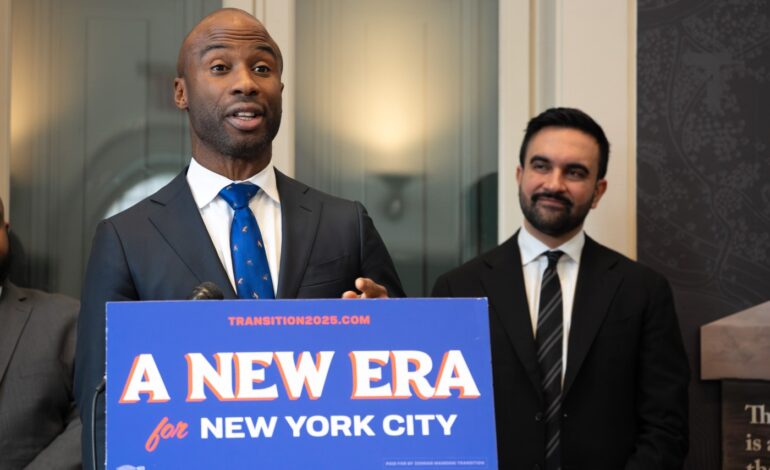

In a significant shift from a key campaign promise, Zohran Mamdani, the mayor-elect of New York City, announced on December 31, 2025, that he will maintain mayoral control over the city’s public schools. During a press conference in northern Central Park, Mamdani appointed Kamar Samuels, a local superintendent, as the new schools chancellor.
Mamdani stated, “I will be asking the Legislature for a continuation of mayoral control.” While affirming his commitment to this governance model, he emphasized that the approach might change under his leadership. “I will also be committed with my incoming schools chancellor to ensure that the mayoral control we preside over is not the same one that we oversee today,” he added, just hours before his official swearing-in ceremony set for the following day.
Throughout his campaign, Mamdani expressed a desire to decentralize authority within the school system, advocating for greater involvement from students, parents, and school staff. However, he did not clarify whether he would relinquish any of his powers related to appointing the chancellor or diminishing that individual’s influence.
Currently, the mayor has the authority to select the chancellor and appoint the majority of members to the Panel for Educational Policy, a body that functions similarly to school boards in other districts. This structure typically ensures alignment between the panel’s decisions and the directives from City Hall. However, recent developments have indicated a shift, with the outgoing administration experiencing challenges to this dynamic. Notably, the board recently moved to shorten the extension of outdated school bus contracts.
Education policy expert David Bloomfield, a professor at Brooklyn College and the CUNY Graduate Center, remarked that Mamdani’s selection of Samuels is a strong endorsement of mayoral control, which he described as unexpected. Mamdani acknowledged his previous skepticism toward mayoral control, admitting, “With the appointment of Kamar, I want to acknowledge I have been skeptical of mayoral control in the past, even at times going so far as wanting to end the system entirely.”
He continued, “So though I have concerns about mayoral control, I also acknowledge that New Yorkers need to know where the buck stops: With me.” Mamdani reiterated his commitment to enhancing family engagement, stating that he aims to empower parent coordinators and restructure meetings to accommodate working parents.
Former chancellors have forcefully defended the need for mayoral control in the city’s schools. David Banks, the previous schools chief, had publicly stated that he would not remain in the position without that governance structure. The outgoing chancellor, Melissa Aviles-Ramos, expressed her accomplishments under mayoral control and indicated that she could achieve even more if that system remained in place. Some advocates had suggested retaining Aviles-Ramos temporarily for stability while seeking broader changes in governance.
Despite calls for reform, there appears to be limited enthusiasm in Albany for significant alterations to the current governance model. Supporters of Samuels, who has over two decades of experience within the city’s education system, suggest he is well-equipped to navigate the school system during this transitional phase.
Samuels began his career as an elementary school teacher and later served as a middle school principal in the Bronx. He gained recognition while leading District 13 in Brooklyn for implementing a districtwide middle school integration plan and has recently managed District 3 in Manhattan. He is also a public school parent to two children. Under his leadership, literacy rates have improved, and access to rigorous International Baccalaureate programs has expanded. He successfully secured over $10 million to promote racial integration through revised admissions policies and school mergers.
“I have had every role, and in every role, my focus has been the same: Delivering results rooted in care, clarity and high expectations for our students,” Samuels stated.
The announcement of Samuels’ appointment was originally scheduled for December 30, 2025, but was postponed, leading to speculation among transition team sources regarding the change in plans. Mamdani ultimately held a separate conference at Elmhurst Hospital Center in Queens to introduce other key appointments, including Helen Arteaga as deputy mayor for health and human services. Arteaga clarified that the shift in venue was her request, aimed at highlighting her professional journey associated with the hospital.
Samuels is expected to officially assume his role as chancellor on January 1, 2026, just prior to the resumption of classes following the winter break. Aviles-Ramos has agreed to assist in the transition for one month, ensuring continuity during this period of change.