


Astronomers Uncover Rare Rogue Planet with Saturn-like Mass
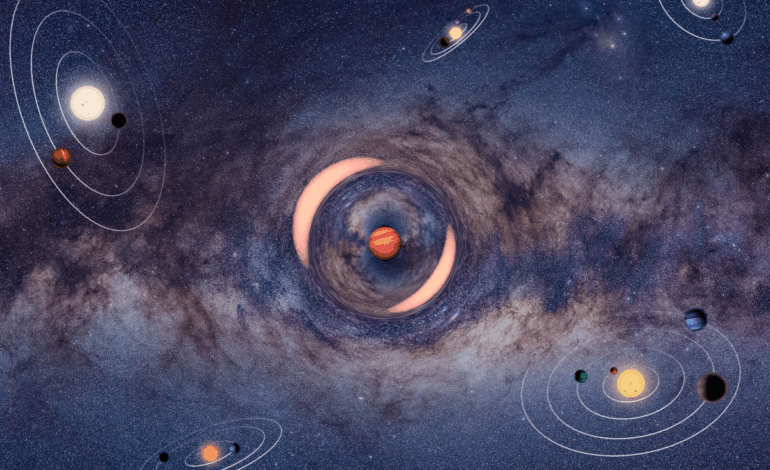

Astronomers have successfully detected a rogue planet with a mass comparable to that of Saturn, expanding our understanding of celestial bodies that exist without a stellar companion. This discovery, made by a team led by Subo Dong from Peking University, utilized both ground-based observations and data from the Gaia space telescope, located approximately 930,000 miles from Earth.
The rogue planet, estimated to be around 22 percent the mass of Jupiter, was identified during a brief microlensing event, a phenomenon that allows astronomers to observe the subtle gravitational effects these planets have on light from distant stars. Unlike traditional planets that orbit stars, rogue planets exist independently and typically reveal their presence through these gravitational interactions.
Understanding Rogue Planet Formation
While rogue planets are often difficult to study due to their lack of emitted light, the team managed to analyze slight variations in the timing of light arrival at different observational points. This methodology enabled them to calculate the planet’s mass and distance from Earth, placing it approximately 3,000 parsecs from the center of the Milky Way. The researchers suggest that this planet likely formed within a planetary system before being ejected due to gravitational disturbances from neighboring celestial bodies or unstable stellar companions.
Previous studies have uncovered a small number of free-floating planets, but determining their distance and mass has remained a significant challenge. The current findings provide a clearer picture of how such planets may be formed and subsequently cast adrift into interstellar space.
The Future of Rogue Planet Research
As scientists continue to explore the universe, the advent of advanced observational technologies promises to enhance our understanding of these elusive entities. The upcoming launch of the NASA Nancy Grace Roman Space Telescope, scheduled for 2027, is expected to facilitate the detection of more rogue planets. This could lead to more precise measurements of their distance and mass, reducing the speculative nature of current research.
The study, published in Science in March 2026, highlights the potential for future discoveries in the field of astronomy. As the tools available to scientists improve, our comprehension of rogue planets and their role in the cosmos may undergo a significant transformation, offering new insights into the diverse pathways of planetary development.
This groundbreaking discovery not only adds to the growing body of evidence surrounding rogue planets but also emphasizes the importance of continued exploration and observation in understanding our universe.