

Asian Markets Dip as China Conducts Military Drills Near Taiwan
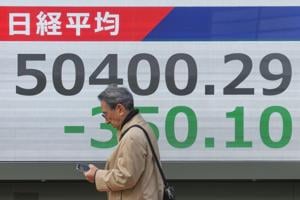

Asian shares experienced a decline during thin holiday trading, primarily influenced by China‘s military exercises near Taiwan. Despite these tensions, Taiwan’s stock market showed resilience, with its benchmark index rising. Meanwhile, the prices of gold and silver fell from recent highs, while oil prices saw an upward trend.
China’s military drills were described as a response to what it deemed “separatist forces” and “external interference.” In reaction, Taiwan heightened its military readiness and labeled the Beijing government as “the biggest destroyer of peace.” These exercises followed China’s dissatisfaction over recent arms sales from the United States to Taiwan and comments from Japan‘s Prime Minister, Sanae Takaichi, regarding Japan’s potential involvement in any conflict concerning Taiwan.
Taiwan’s benchmark Taiex gained 0.9% despite the military drills. In contrast, the Hang Seng index in Hong Kong fell by 0.7% to 25,637.69. The Shanghai Composite index remained relatively stable at 3,965.28, while Tokyo’s Nikkei 225 slipped 0.4% to 50,526.92. In South Korea, the Kospi surged 2.2% to 4,220.56, approaching its all-time record, largely driven by a 6.8% increase in shares of SK Hynix, following a regulatory change that lifted an investment warning on its stock.
In the precious metals market, the price of gold dropped 1.3% to $4,494 per troy ounce, while silver declined 2.4% to $75.30. These declines came after significant recent gains, driven by investors seeking safe havens amid economic uncertainty. The fluctuations in gold prices were also influenced by concerns surrounding a potential U.S. government shutdown and expectations that the U.S. Federal Reserve may reduce interest rates further in the upcoming year, which could weaken the dollar and boost gold buying.
Stephen Innes of SPI Asset Management noted the critical role of China in the global silver refining market, stating, “Scarcity is no longer theoretical. China sits at the center of global silver refining, and when the world’s top refiner starts tightening the valve, downstream users feel it immediately.”
In the U.S. markets, trading has been muted as institutional investors largely concluded their activities for the year. On the last trading day before the holiday, the S&P 500 index saw a slight decline of less than 0.1%, while the Dow Jones Industrial Average also fell less than 0.1%. The Nasdaq composite experienced a similar decrease of 0.1%. The S&P 500 has gained nearly 18% this year, buoyed by regulatory changes and growing optimism about artificial intelligence.
In the energy sector, U.S. benchmark crude oil rose 68 cents to $57.42 per barrel, with Brent crude increasing by 66 cents to $60.90 per barrel. This follows a recent decline in oil prices, with U.S. crude falling 2.8% and Brent crude dropping 2.6% on the previous Friday. The U.S. dollar weakened against the Japanese yen, declining to 156.23 yen from 156.56 yen, while the euro rose slightly to $1.1777 from $1.1770.
As market dynamics continue to evolve, investors will be closely monitoring geopolitical developments and their implications for global financial markets.