


NYC School Phone Ban Reveals Students’ Struggles with Clocks
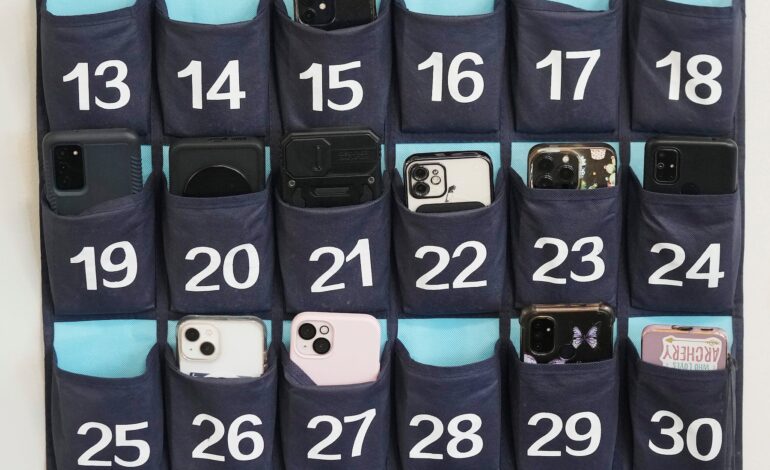

The statewide smartphone ban in New York City schools has successfully enhanced student focus and social interactions during lunch, but it has also brought to light a surprising skill gap: many students struggle to read traditional analog clocks. As of June 2025, New York is among 21 states plus Washington D.C. implementing a “bell to bell” smartphone ban in educational settings.
Teachers have observed that while the ban encourages greater engagement, it has also highlighted a lack of familiarity with reading analog timepieces. Tiana Millen, an assistant principal at Cardozo High School in Queens, noted, “That’s a major skill that they’re not used to at all.” English teacher Madi Mornhinweg from Manhattan echoed this sentiment, revealing that students frequently inquire about the time. “The constant refrain is ‘Miss, what time is it?’” Mornhinweg stated. “It’s a source of frustration because everyone wants to know how many minutes are left in class.”
According to the New York City Department of Education, students are taught to read clocks in first and second grade. Isla Gething, a department spokesperson, emphasized the importance of teaching both analog and digital time-telling skills. “At NYCPS, we recognize how essential it is for our students to tell the time on both analog and digital clocks,” Gething said. “As our young people are growing up in an increasingly digital world, no traditional time-reading skills should be left behind.”
A lack of practice appears to be the root cause of this issue, with students like Cheyenne Francis, 14, pointing out that her peers have “forgotten that skill because they never used it, because they always pulled out their phone.” The presence of broken or incorrectly set clocks in school buildings further compounds the problem, as reported by Gothamist.
Teachers are attempting to bridge the gap by integrating time-telling into their lessons. Travis Malekpour, who teaches English and math at Cardozo, described the skill as “underutilized” and has incorporated clock-reading and calendar management into some algebra classes. This approach aims to keep the skill relevant in students’ lives.
The shift towards digital tools raises questions about cognitive development. Kris Perry, the executive director of Children and Screens: Institute of Digital Media and Child Development, noted that teens raised in a digital environment may not have practiced reading analog clocks. Perry stated, “The question is whether the shift amounts to a cognitive downgrade or just a replacement.” She cited brain scans showing that engaging with physical books and handwriting often leads to more brain activity compared to reading and typing on screens.
Nonetheless, some educators argue the benefits of a tech-savvy student body. Many schools now have advanced coding and robotics programs, allowing students to assist teachers with technology. Mornhinweg shared a recent experience where students helped her navigate new software. “I was freaking out and they were like, ‘Miss it’s fine, this is what you do.’ I felt really old,” she admitted.
As the debate continues over the implications of digital reliance in education, the challenges posed by the smartphone ban have sparked important discussions about essential skills that should not be overlooked. The ability to read traditional clocks may seem minor, but it represents a larger shift in how students interact with time and technology in their daily lives.