


Astronomers Unveil New Method to Analyze Galaxy Clusters’ Secrets
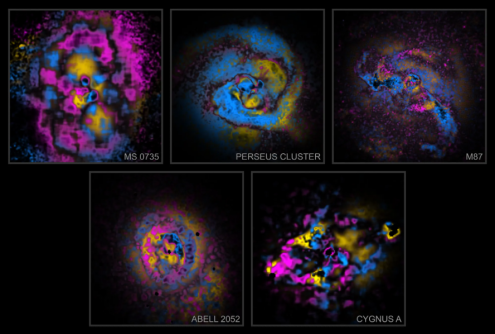

Astronomers have developed a groundbreaking technique to analyze galaxy clusters, the largest gravitationally bound structures in the Universe, which contain thousands of galaxies and massive amounts of superheated gas. This innovative method, known as “X-arithmetic,” enables scientists to classify features within galaxy clusters based on their physical properties rather than their appearance alone.
Galaxy clusters serve as vital indicators of cosmic evolution, holding approximately five times the mass of their galaxies in hot gas and significantly more mass in dark matter, which accounts for about 80% of their total mass. The Chandra X-ray Observatory, operated by NASA, has played a crucial role in studying these cosmic giants. With its advanced X-ray vision, Chandra captures images of gas heated to temperatures reaching 100 million degrees Celsius, offering insights into the dynamic processes occurring within these clusters.
Innovative Technique Enhances Understanding of Black Hole Activity
The new X-arithmetic approach allows researchers to analyze X-ray data from 15 galaxy clusters and groups, enabling a deeper understanding of the physical processes at play. By comparing X-ray signals across different energy levels, the team can categorize structures within the clusters into distinct types, each represented by a specific color. For example, pressure disturbances that travel at nearly the speed of sound are indicated in pink, while bubbles formed by black hole jets appear in yellow, and cooler gas is represented in blue.
According to a study published in The Astrophysical Journal, this technique not only enhances the interpretation of Chandra’s X-ray data but also links theoretical simulations of galaxy clusters with observed phenomena. The new findings illustrate key differences between galaxy clusters like Abell 2052 and Cygnus A and smaller galaxy groups.
Researchers found that galaxy clusters often contain large areas of cooling gas near their centers. In contrast, galaxy groups exhibit multiple shock fronts and less cooling gas. This disparity suggests that the feedback from black holes—where energy released during outbursts influences their surroundings—is more pronounced in galaxy groups. The dynamics may vary because the weaker gravitational forces in groups allow black hole outbursts to have a more significant impact.
Implications for Cosmic Understanding
The research team, led by Hannah McCall from the University of Chicago, includes notable contributors such as Irina Zhuravleva, Eugene Churazov from the Max Planck Institute for Astrophysics, and others from esteemed institutions. Their work has opened new avenues for investigating how black holes influence the formation of stars and regulate the cooling of hot gas in galaxy clusters.
Despite the advancements, many questions remain regarding the frequency and energy output of black hole outbursts. Understanding these phenomena is crucial for grasping the broader implications of black hole activity on cosmic scales.
As researchers continue to explore these cosmic titans, the X-arithmetic technique promises to enhance our comprehension of the Universe’s evolution. The Chandra program, managed by NASA’s Marshall Space Flight Center, along with operations conducted by the Smithsonian Astrophysical Observatory’s Chandra X-ray Center, remains at the forefront of this groundbreaking research.