

Researchers Create Eco-Friendly Heat Dissipation Material Using Egg Whites
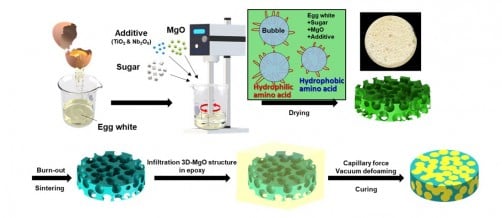

A research team led by Dr. Hyun-Ae Cha from the Korea Institute of Materials Science (KIMS) has engineered a high-performance composite material designed for effective heat dissipation. This innovative material, inspired by the foaming properties of egg whites, combines eco-friendliness with cost-effective processing methods. The resulting structure significantly enhances thermal conductivity, achieving levels up to 2.6 times greater than traditional heat-dissipating composites.
As electronic devices become increasingly compact and powerful, the heat they generate is a growing concern. In particular, electric vehicles (EVs) require precise thermal management systems to prevent overheating, which can lead to performance issues or even fires. Central to these systems is the Thermal Interface Material (TIM), which is essential for efficiently transferring heat.
Conventional TIMs are typically created by mixing thermally conductive fillers into a polymer matrix. However, this method often results in uneven distribution of the fillers, causing interruptions in thermal pathways and limiting performance. While increasing the amount of filler can enhance thermal conductivity, it complicates processing and raises material costs, restricting scalability.
Innovative Use of Egg White Proteins
To overcome these challenges, the research team implemented a novel protein foaming technique. By utilizing the properties of egg white proteins that expand at high temperatures, they crafted a three-dimensional (3D) network of interconnected particles. This structure allows for continuous thermal pathways, facilitating efficient heat transfer and resulting in a TIM with a thermal conductivity of 17.19 W/m·K.
A significant advantage of this new composite is its use of magnesium oxide (MgO), a lightweight and affordable material. The developed composite not only outperforms commonly used aluminum oxide (Al2O3) but also rivals nitride-based heat-dissipating materials. By integrating this composite with epoxy resin, typically utilized to enhance adhesion with thermal fillers, the team successfully produced a practically applicable material for real-world applications.
The implications of this breakthrough are substantial. The new material is poised to improve the performance and stability of various devices that generate significant heat, including semiconductor packages, 5G communication devices, and high-performance servers. The domestic market for TIMs in South Korea alone is expected to exceed KRW 200 billion annually, with a heavy reliance on imports. The successful commercialization of this technology will bolster South Korea’s self-sufficiency in thermal management materials.
Dr. Cha emphasized the importance of their work, stating, “Through the protein foaming–based process, we can produce high–thermal–conductivity materials in an eco-friendly and cost-effective way.” She further noted, “This study serves as a strong example demonstrating the feasibility of developing lightweight, high-performance heat-dissipating materials.”
This research was funded by the Nano Materials Technology Development Program of the National Research Foundation of Korea (NRF). The findings were published on May 28, 2023, in the prestigious journal Advanced Science, which has an impact factor of 15.1, and was featured as the cover article for Volume 12, Issue 33.
The advancements made by Dr. Cha’s team not only pave the way for enhanced thermal management solutions but also highlight the innovative potential of utilizing natural materials in modern technology. As industries continue to seek sustainable and efficient solutions, this research represents a significant step forward in materials science.