
Korean Researchers Pioneer Magnetic Cooling Technology for Eco-Friendly Refrigeration

A research team from the Korea Institute of Materials Science (KIMS) has developed South Korea’s first full-cycle magnetic cooling technology. This innovative approach addresses environmental concerns associated with traditional gas-based refrigeration methods. Led by Dr. Jong-Woo Kim from the Nano Materials Research Division and Dr. Da-Seul Shin from the Materials Processing Research Division, the project aims to introduce eco-friendly, high-efficiency cooling solutions to the market.
This magnetic cooling technology operates without gas refrigerants, relying instead on the magnetocaloric effect. This phenomenon allows the temperature of a refrigerant material to change when exposed to an external magnetic field, providing a sustainable alternative to conventional cooling systems. Despite the promise of this technology, challenges remain, particularly regarding the high manufacturing costs of magnetocaloric materials and their reliance on rare-earth elements, which complicate price competitiveness.
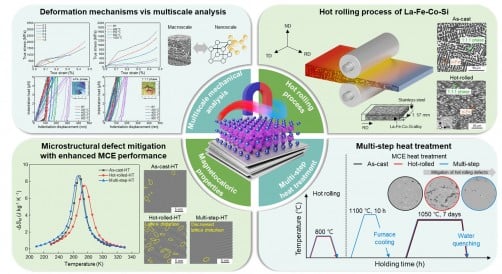
The research team has synthesized various magnetocaloric materials, including lanthanum (La)-based and manganese (Mn)-based alloys. Through advanced fabrication techniques such as hot rolling, cold drawing, and micro-channel machining, they successfully created thin sheets and fine wires vital for industrial applications. Notably, they achieved large-area La-based thin sheets measuring 0.5 mm thick and Gd-based fine wires with a diameter of 1.0 mm, demonstrating exceptional performance at the component level.
In addition to these advancements, the team developed Korea’s first measurement system capable of directly monitoring adiabatic temperature changes in magnetic cooling materials and components. This innovation enables quantitative verification of property differences based on manufacturing processes, facilitating the development of optimized materials for magnetic cooling applications.
As global regulations on refrigerants tighten, the need for alternative cooling technologies becomes increasingly urgent. Under the Kigali Amendment to the Montreal Protocol, the production and use of major gas refrigerants, including HFCs, HCFCs, and R22, will be entirely banned after 2030. Furthermore, the use of disposable refrigerant containers, including those containing recycled refrigerants, will face strict prohibitions.
Research from technologically advanced countries, such as Germany, indicates that magnetic cooling systems are achieving coefficients of performance (COP) that surpass those of conventional refrigeration methods. This trend highlights magnetic refrigeration technology as a potential core solution in the global market, aligning with international decarbonization policies and climate change initiatives.
In response to these developments, the KIMS research team is committed to enhancing their technological competitiveness through impactful publications and patents. They have demonstrated international competitiveness in the manufacturing of components and non-rare-earth magnetic refrigerant materials. Dr. Jong-Woo Kim emphasized, “Once commercialized, this technology will overcome the limitations of conventional gas-based cooling systems and provide an eco-friendly and stable cooling solution.”
Additionally, Dr. Da-Seul Shin stated, “Through this creative convergence research project, we aim to further advance magnetocaloric technology and establish a domestic industrial infrastructure for it, while also expanding into the global market.”
The project received funding from the Basic Research Program of KIMS and the Creative Convergence Research Program of the National Research Council of Science and Technology (NST). The research findings were published in May 2025 in the prestigious academic journal Rare Metals, with Ph.D. candidate Sun-Young Yang as the first author. The team has also registered a domestic patent related to the magnetic cooling evaluation system and has submitted a corresponding patent application in the United States.
Overall, this development marks a significant step toward the future of refrigeration, aligning with global efforts to address climate change while providing efficient cooling solutions.